
El Niño in Orange County
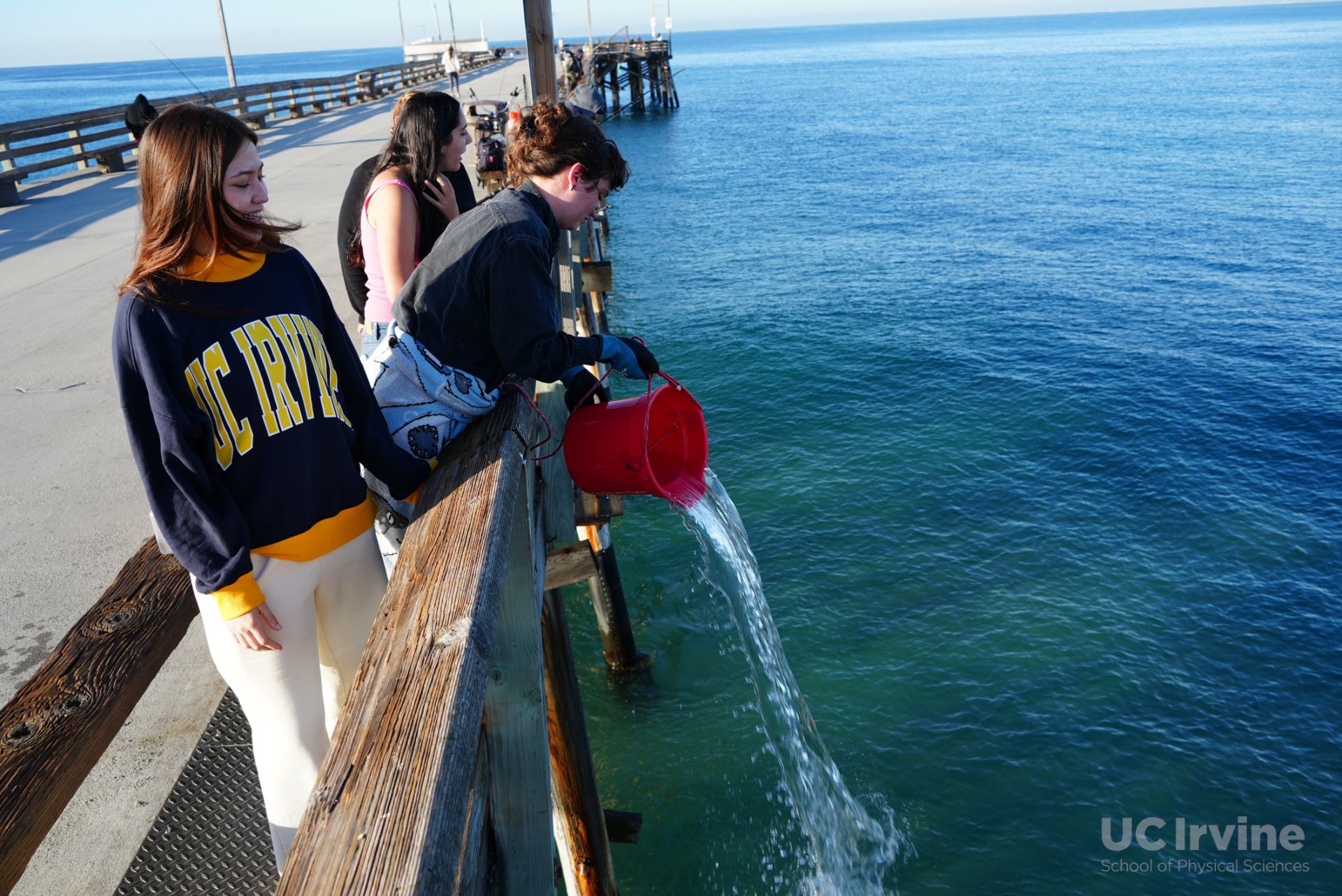
Students from the lab of Professor Katherine Mackey in the UC Irvine Department of Earth System Science sample ocean water off Newport Pier in Nov. 2026. Mackey explained how studying the ocean and the microorganisms that live in it provides a window into how food webs may change along OC coasts in the future as this year’s super El Niño unfolds. “One reason it’s important for us to study native California phytoplankton responses to the current El Niño is that this strong El Niño year is a harbinger of things to come,” Mackey said. “Climate warming and associated changes in ocean currents and coastal nutrient supply are likely to alter the future conditions of California’s coastal ocean, which could start to take on more persistent El Niño-like characteristics.”
Early in the morning on Tuesday Nov. 3, a group of UC Irvine students from the lab of Professor Katherine Mackey in the Department of Earth System Science stood at the edge of Newport Pier and tossed an orange bucket into the ocean. Surfers cruised past and watched as the team hauled the bucket, now filled with seawater, back up to the pier where they poured the water into bottles before rushing the fresh samples back to labs at UCI for analysis.
It was the Earth science equivalent of drawing a sample of blood from a patient exhibiting unusual symptoms. Only here the patient is Earth, and its symptoms, which include shifts in rainfall patterns and more powerful ocean swells that may contribute to flooding along the OC coastline, point to a clear diagnosis: super El Niño.
El Niño happens every two to seven years, and it brings changes to the climate that yield unusually warm waters in the eastern tropical Pacific Ocean. This year, scientists are calling it a “super El Niño” because it’s the strongest El Niño ever recorded, and the precise effects it may have – from increased rainfall to shifts in sea level – are still largely uncertain.
Still, measurable changes are already underway, including in Southern California where ocean water temperatures are rising to abnormal levels.
“We just heard from a local surfer that it’s about 70 degrees right now here, even though it’s November,” said Katie Shore, a graduate student in Mackey’s lab who led the team collecting ocean water at Newport pier.
Warm waters generated by El Niño can impact marine animals, starting with microorganisms called phytoplankton, which form the bases of food webs.
“We’re seeing a lot less upwelling of deep ocean water than usual, which is typical of El Niño,” Shore said. “This means that there is less cold water coming up from the deep ocean to the surface, which can play into overall less phytoplankton in the water.”
Mackey and her team aren’t the only UCI scientists monitoring the planet’s vitals.
In a Nov. 4 lecture at UCI, Earth system science professor Jin-Yi Yu explained how the 2026 El Niño will only continue intensifying in the coming months.
“This year we have an historical event,” Yu said. “We’ve never seen a El Niño so strong in our modern era.”
Yu’s group is sorting out if this year’s super El Niño will resemble the 1997-98 El Niño, which brought above-normal rainfall to California, or the 2015-16 El Niño, which brought below-normal rainfall to Southern California.
“A strong El Niño does not necessarily guarantee a wet winter in California,” Yu said.
The key to what lies ahead is whether the pattern of warming in Pacific waters develops in a way that favors wetter weather in California.
“2026 has already become the strongest El Niño of the modern era, and it’s still intensifying. But whether it brings more rainfall to California also depends on whether the warm waters are located in the right region of the Pacific,” Yu said.
Yu described how a unique feature of the 2026 super El Niño is exceptionally strong ocean surface warming off the coasts of Baja California and Southern California – something that could influence weather patterns in the near future.
To further constrain temperature changes in Pacific waters, Earth System Science professor Henri Drake’s research group is developing a new theoretical framework called Anomalous Water Mass Transformation that aims to quantify how much warm water lies below the ocean surface, understanding how and where such warm waters are formed and tracking their evolution across space.
The research promises to lead to a better understanding of how past super El Niño events formed, which could lead to more accurate forecasts that detail what communities in places like Southern California can expect.
“In addition to there being record high sea surface temperatures in the East Pacific Ocean in 2026, there is also a record high volume of relatively warm water – about 2 degrees Celsius or more than usual – still lurking just below the surface, consistent with forecasts that this super El Niño will still be around for several more months,” Drake said. “Since seawater expands by about 0.2 percent per 1 degree Celsius of warming, this warming alone would raise sea levels there by about a foot. Exactly how these changes in the open ocean are contributing to the high coastal sea levels we’re seeing here in California remains an open question.”
Meanwhile, the National Oceanic and Atmospheric Administration forecasts increased precipitation for Southern California in the months ahead.