| CRM / DEAD / Doc / dust / ESS / FACTs / NCO / Poetry / Zender |
| Absorption / Abstracts / Activism / Aerosols / Biography / CheatSheets / Collaborations / Courses / CV / C&P / LaTeX / Monographs / Opportunities / People / Pictures / Posters / Press / Projects / Proposals / Publications / Research / Seminars / Software / More Links… |
|
|
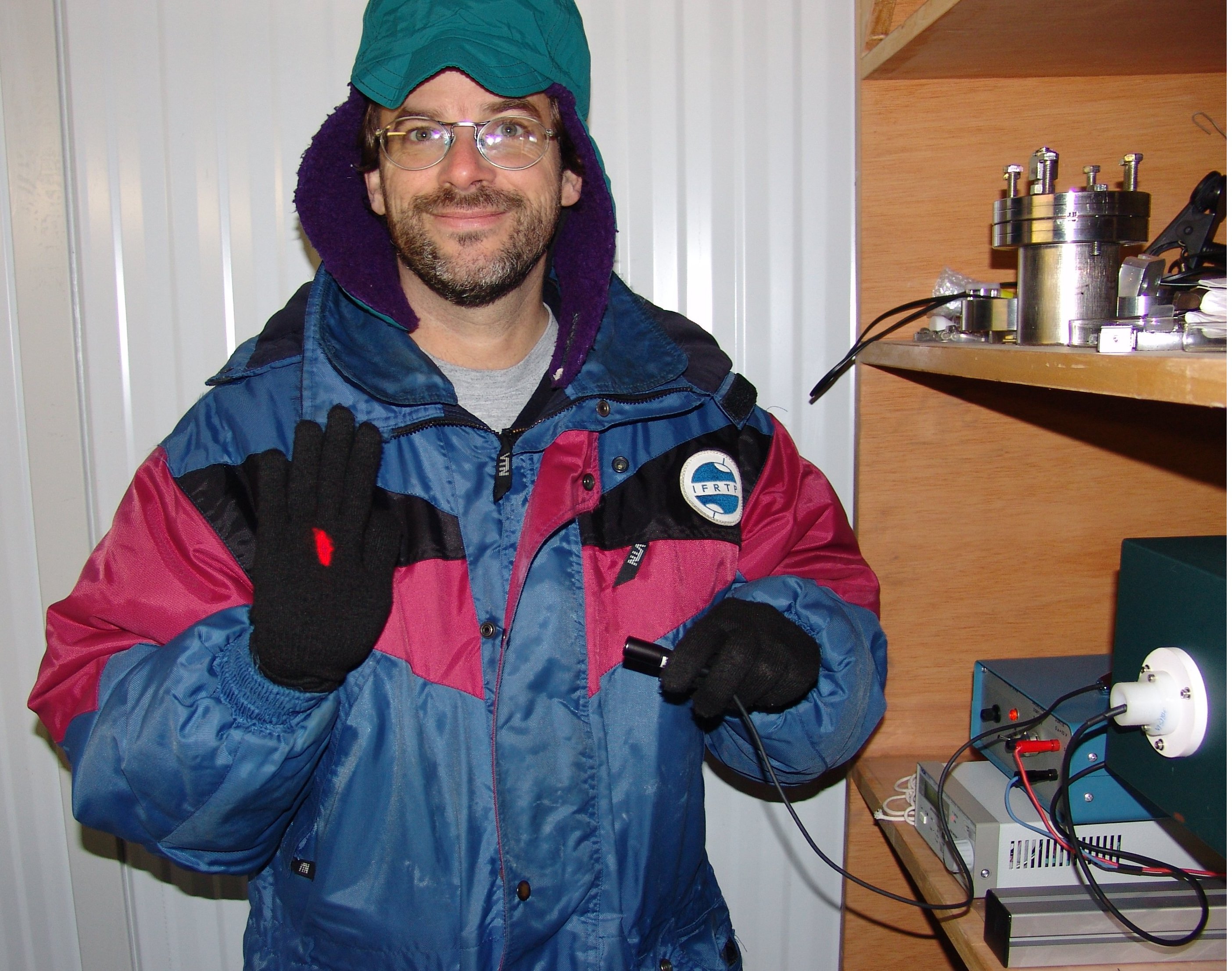
Measuring snow reflectance with lasers in LGGE's −15C coldroom
The CHARM group works through a transport algorithm |
Earth System Science: Dr. Zender's recent climate research focuses on aerosol-climate interactions. He works to understand and predict wind erosion (including soil loss); mineral and nutrient re-distribution by dust; chemical, radiative, and health effects of dust; and the fundamental physics of natural aerosol mobilization, dispersal, and deposition; and snowpack, a sensitive and efficacious modulator of Earth's climate. Others consider him a modeler, though he can swear like an observationalist. He wants to participate in field experiments. Invite him and see.
Computer Science: Dr. Zender's recent computer science research focuses on efficient analysis of gridded datasets with storage-layer constraints. Mainly he works to accelerate and simplify analysis of this type of self-describing geoscience data in order to further climate research. Increasingly, ensembles of geoscience datasets are analyzed and intercompared with observations. Our group is pioneering a new paradigm called Group-Oriented Data Analysis and Distribution (GODAD) that facilitates such analysis. GODAD lets the scientific question organize the data, not the ad hoc granularity of all relevant datasets. xsThe NCO User Guide illustrates GODAD techniques for climate data analysis:
 “Lightweight Climate Analysis Tools for ACME” is our
contribution
to the
Accelerated Climate Modeling for Energy (ACME)
project,
a part of DOE's Earth System Modeling (ESM)
program.
ACME supports two separate projects in our group.
First, we are making parallel regridding and workflows in NCO accessible through UV-CDAT.
Spatially intelligent software tools is a key component of the
Group-Oriented Data Analysis and Distribution
(GODAD) paradigm we
are developing for geoscience data analysis.
Second, we are are improving and harmonizing
(description)
the radiative treatments of snow, sea-ice, and melt ponds across the ACME models.
This extends the SNow, ICe, and Aerosol Radiative (SNICAR) model
capabilities, and will permit novel scientific experiments on the role
of sea-ice and pollution/impurities alone and in the coupled climate system.
“Lightweight Climate Analysis Tools for ACME” is our
contribution
to the
Accelerated Climate Modeling for Energy (ACME)
project,
a part of DOE's Earth System Modeling (ESM)
program.
ACME supports two separate projects in our group.
First, we are making parallel regridding and workflows in NCO accessible through UV-CDAT.
Spatially intelligent software tools is a key component of the
Group-Oriented Data Analysis and Distribution
(GODAD) paradigm we
are developing for geoscience data analysis.
Second, we are are improving and harmonizing
(description)
the radiative treatments of snow, sea-ice, and melt ponds across the ACME models.
This extends the SNow, ICe, and Aerosol Radiative (SNICAR) model
capabilities, and will permit novel scientific experiments on the role
of sea-ice and pollution/impurities alone and in the coupled climate system.
 “Simplifying and accelerating model evaluation by NASA satellite data”
is National Aeronautics and Space Administration Cooperative Agreement (CA)
NNX12AF48A, aka our
ACCESS 2013 project,
a part of NASA's
Advancing Collaborative Connections for Earth System Science
(ACCESS)
program.
The ACCESS 2013 project provides the resources to implement support in NCO
for Swath-like data (SLD), i.e., dataset with non-rectangular and/or
time-varying spatial grids in which one or more coordinates are multi-dimensional.
It is often challenging and time-consuming to work with SLD,
including all NASA Level 2 satellite-retrieved data, non-rectangular
subsets of Level 3 data, and model data (e.g., CMIP5) that are
increasingly stored on non-rectangular grids.
Spatially intelligent software tools is a key component of the
Group-Oriented Data Analysis and Distribution
(GODAD) paradigm we
are developing for geoscience data analysis.
“Simplifying and accelerating model evaluation by NASA satellite data”
is National Aeronautics and Space Administration Cooperative Agreement (CA)
NNX12AF48A, aka our
ACCESS 2013 project,
a part of NASA's
Advancing Collaborative Connections for Earth System Science
(ACCESS)
program.
The ACCESS 2013 project provides the resources to implement support in NCO
for Swath-like data (SLD), i.e., dataset with non-rectangular and/or
time-varying spatial grids in which one or more coordinates are multi-dimensional.
It is often challenging and time-consuming to work with SLD,
including all NASA Level 2 satellite-retrieved data, non-rectangular
subsets of Level 3 data, and model data (e.g., CMIP5) that are
increasingly stored on non-rectangular grids.
Spatially intelligent software tools is a key component of the
Group-Oriented Data Analysis and Distribution
(GODAD) paradigm we
are developing for geoscience data analysis.
We are recruiting (PDF, TXT) a programmer (aka software engineer) or postdoc based at UCI for at least two years, to accomplish our ACCESS objectives. As described in the proposal, this person will be responsible for incorporating geospatial features and parallelism into NCO.

The National Science Foundation Grant NSF ICER-1541031 funded the Unidata-led EarthCube Project, “EarthCube IA: Collaborative Proposal: Advancing netCDF-CF for the Geoscience Community” from 20150901–20170831 as part of the Integrative and Collaborative Education and Research (ICER) program. UCI's primary role is to help extend CF to cover hierarchical data structures, aka groups. Groups are the Group-Oriented Data Analysis and Distribution (GODAD) paradigm we are developing for geoscience data analysis. We will convene workshops for interested stakeholders in 2016 and 2017.
 ESS 5: The Atmosphere ESS 11: Climate Change and Policy ESS 55: Earth's Atmosphere ESS H90: The Idiom and Practice of Science: Geoengineering ESS 110: Environmental Controversies ESS 112: Global Climate Change and Policy ESS 138: Remote Sensing ESS 172/272: Science Communication and Outreach ESS 200: Global Physical Climatology ESS 204B: The Planetary Boundary Layer ESS 223: Earth System Physics ESS 231: Global Hydrology ESS 236: Radiative Processes & Remote Sensing ESS 282: Topics in Climate: Global Climate Modeling ESS 282: Topics in Climate: Aerosol-Cloud-Climate Interactions ESS 286: Topics in Biogeochemistry: Chemistry, Composition, and Climate ESS 286: Topics in Biogeochemistry: Land Surface Modeling ESS 291: Research Seminar ESS 298: Practicum in Earth System Science
Gorris, M. E., L. A. Cat, M. Matlock, O. A. Ogunseitan, K. K. Treseder, J. T. Randerson, and C. S. Zender (2020),
Coccidioidomycosis (Valley fever) case data for the southwestern United States,
Open Health Data, 7(1), doi:10.5334/ohd.31.
PDF (© 2020 by M. Gorris)
Gorris, M. E., K. K. Treseder, C. S. Zender, and J. T. Randerson (2019),
Expansion of coccidioidomycosis endemic regions in response to climate change in the United States during the 21st century,
GeoHealth, 3(10), 308–327, https://doi.org/10.1029/2019GH000209.
PDF (© 2020 by the AGU)
Dang, C., C. S. Zender, and M. G. Flanner (2019), Intercomparison and improvement of two-stream shortwave radiative transfer schemes in Earth system models for a unified treatment of cryospheric surfaces, The Cryosphere, 13(9), 2325–2343, doi:10.5194/tc-13-2325-2019.
PDF (© 2019 by the authors)
Wang, W., C. S. Zender, D. van As, and N. B. Miller (2019), Spatial distribution of melt-season cloud radiative effects over Greenland: Evaluating satellite observations, reanalyses, and model simulations against in situ measurements, J. Geophys. Res. Atm., 124, doi:10.1029/2018JD028919.
PDF (© 2019 by the AGU)
Wang, W., C. S. Zender, and D. van As (2018), Temporal Characteristics of Cloud Radiative Effects on the Greenland Ice Sheet: Discoveries from Multiyear Automatic Weather Station Measurements, J. Geophys. Res. Atm., 123, doi:10.1029/2018JD028540.
PDF (© 2018 by the AGU)
Stephenson, S. R., W. Wang, C. S. Zender, H. Wang, S. Davis, and P. J. Rasch (2018), Climatic Responses to Future Trans-Arctic Shipping, Geophys. Res. Lett., 45, doi:10.1029/2018GL078969.
PDF (© 2018 by the AGU)
Parajuli, S. P., and C. S. Zender (2018), Projected changes in dust emissions and regional air quality due to the shrinking Salton Sea, Aeolian Research, 33, 82–92, doi:10.1016/j.aeolia.2018.05.004.
PDF (© 2018 by the authors)
Gorris, M. E., L. A. Cat, C. S. Zender, K. K. Treseder, and J. T. Randerson (2018), Coccidioidomycosis dynamics in relation to climate in the southwestern United States, GeoHealth, 2(1), 6–24, https://doi.org/10.1002/2017GH000095.
PDF (© 2018 by the AGU)
Parajuli, S. P., and C. S. Zender (2017), Connecting geomorphology to dust emission through high-resolution mapping of global land cover and sediment supply, Aeolian Research, 27, 47–65, doi:10.1016/j.aeolia.2017.06.002.
PDF(© 2017 by the authors)
Silver, J. D. and C. S. Zender (2017), The compression-error trade-off for large gridded data sets, Geosci. Model Dev., 10, 413–423, doi:10.5194/gmd-10-413-2017.
BibTeX
PDF (GMD) (© 2017 by the authors)
Zender, C. S. (2016), Bit Grooming: Statistically accurate precision-preserving quantization with compression, evaluated in the netCDF Operators (NCO, v4.4.8+), Geosci. Model Dev., 9, 3199–3211, doi:10.5194/gmd-9-3199-2016.
BibTeX
PDF (GMD) (© 2016 by me)
Wang, W., C. S. Zender, D. van As, P. C. J. P. Smeets, and M. R. van den Broeke (2016), A Retrospective, Iterative, Geometry-Based (RIGB) tilt correction method for radiation observed by automatic weather stations on snow-covered surfaces: application to Greenland, The Cryosphere, 10, 727–741, doi:10.5194/tc-10-727-2016.
BibTeX
PDF (TC) (© 2016 by the authors)
Tosca, M. G., J. T. Randerson, and C. S. Zender (2013), Global impact of smoke aerosols from landscape fires on climate and the Hadley circulation, Atmos. Chem. Phys., 13(10), 5227–5241, doi:10.5194/acp-13-5227-2013.
BibTeX
PDF (CSZ)
PDF (JGR) (© 2013 by the authors)
Zender, C. S. (2012), Snowfall brightens Antarctic future, Nature Clim. Change2(11), 770–771, doi:10.1038/nclimate1730.
BibTeX
PDF (CSZ)
PDF (NCC) (© 2012 by NPG)
Han, Q., C. S. Zender, J. K. Moore, C. S. Buck, Y. Chen, A. Johansen, and C. I. Measures (2012), Global estimates of mineral dust aerosol iron and aluminum solubility that account for particle size using diffusion-controlled and surface-area-controlled approximations, Global Biogeochem. Cycles, 26, GB2038, doi:10.1029/2011GB004816.
BibTeX
PDF (CSZ)
PDF (GBC) (© 2011 by the AGU)
Zender, C. S., A. G. Krolewski, M. G. Tosca, and J. T. Randerson (2012), Tropical biomass burning smoke plume size, shape, reflectance, and age based on 2001–2009 MISR imagery of Borneo, Atmos. Chem. Phys., 12, 3437–3454, doi:10.5194/acp-12-3437-2012.
BibTeX
PDF (CSZ)
PDF (ACP) (© 2012 by the authors)
Wang, X., C. de Linage, J. Famiglietti, and C. S. Zender (2011),
Gravity Recovery and Climate Experiment (GRACE) detection of water storage changes in the Three Gorges Reservoir of China and comparison with in situ measurements, Water Resour. Res., 47, W12502, doi:10.1029/2011WR010534.
BibTeX
PDF (CSZ)
PDF (WRR) (© 2011 by the AGU)
Allen, R. J., and C. S. Zender (2011), The role of eastern Siberian snow and soil moisture anomalies in quasi-biennial persistence of the Arctic and North Atlantic Oscillations, J. Geophys. Res. Atm., 116, D16125, doi:10.1029/2010JD015311.
BibTeX
PDF (CSZ)
PDF (JGR) (© 2011 by the AGU)
Tosca, M. G., J. T. Randerson, C. S. Zender, D. L. Nelson, D. J. Diner, and J. A. Logan (2011), Dynamics of fire plumes and smoke clouds associated with peat and deforestation fires in Indonesia, J. Geophys. Res. Atm., 116, D08207, doi:10.1029/2010JD015148.
BibTeX
PDF (CSZ)
PDF (JGR) (© 2011 by the AGU)
Allen, R. J., and C. S. Zender (2011), Forcing of the Arctic Oscillation by Eurasian Snow Cover, J. Climate, 24(24), 6528–6539, doi:10.1175/2011JCLI4157.1.
BibTeX
PDF (CSZ)
PDF (JCL) (© 2011 by the AMS)
Wang, X., and C. S. Zender (2011), Arctic and Antarctic diurnal and seasonal variations of snow albedo from multiyear Baseline Surface Radiation Network measurements, J. Geophys. Res. Earth Surf., 116, F03008, doi:10.1029/2010JF001864.
BibTeX
PDF (CSZ)
PDF (JGR) (© 2011 by the AGU)
Allen, R. J., and C. S. Zender (2010), The Effects of Continental-Scale Snow Albedo Anomalies on the Wintertime Arctic Oscillation, J. Geophys. Res. Atm., 115, D23105, doi:10.1029/2010JD014490.
BibTeX
PDF (CSZ)
PDF (JGR) (© 2010 by the AGU)
Han, Q. and C. S. Zender (2010), Desert dust aerosol age characterized by mass-age tracking of tracers, J. Geophys. Res. Atm., 115, D22201, doi:10.1029/2010JD014155.
BibTeX
PDF (CSZ)
PDF (JGR) (© 2010 by the AGU)
Tosca, M. G., J. T. Randerson, C. S. Zender, M. G. Flanner, and P. J. Rasch (2009), Do biomass burning aerosols intensify drought in equatorial Asia during El Niño?, Atmos. Chem. Phys., 10(8), 3515–3528, http://www.atmos-chem-phys.net/10/3515/2010.
BibTeX
PDF (CSZ)
PDF (ACP) (© 2010 by the authors)
Wang, X., and C. S. Zender (2010), Constraining MODIS snow albedo at large zenith angles: Implications for the surface energy budget of Greenland, J. Geophys. Res. Earth Surf., 115, F04015, doi:10.1029/2009JF001436.
BibTeX
PDF (CSZ)
PDF (JGR) (© 2010 by the AGU)
Capps, S. B., and C. S. Zender (2010), Estimated global ocean wind power potential from QuikSCAT observations, accounting for turbine characteristics and siting, J. Geophys. Res., 115, L09102, doi:10.1029/2009JD012679.
BibTeX
PDF (CSZ)
PDF (JGR) (© 2010 by the AGU)
Wang, X., and C. S. Zender (2010), MODIS snow albedo bias at high solar zenith angle relative to theory and to in situ observations in Greenland, Rem. Sens. Environ., 114(3), 563–575, doi:10.1016/j.rse.2009.10.014.
BibTeX
PDF (CSZ)
PDF (RSE) (© 2010 by Elsevier Science Inc.)
Capps, S. B., and C. S. Zender (2009), Global Ocean Wind Power Sensitivity to Surface Layer Stability, Geophys. Res. Lett., 36, L09801, doi:10.1029/2008GL037063.
BibTeX
PDF (CSZ)
PDF (GRL) (© 2009 by the AGU)
Wang, D. L., C. S. Zender, and S. F. Jenks (2009), Efficient Clustered Server-side Data Analysis Workflows using SWAMP, Earth Sci. Inform., 2(3), 141–155, doi:10.1007/s12145-009-0021-z.
BibTeX
PDF (© 2009 by Springer-Verlag)
Wang, D. L., C. S. Zender and S. F. Jenks (2008): Cluster Workflow Execution of Retargeted Data Analysis Scripts, in Cluster Computing and the Grid, 2008. CCGRID '08. 8th IEEE International Symposium on. Lyons, France, 19–22 May, 2008. IEEE Computer Society, 449–458, doi:10.1109/CCGRID.2008.69.
BibTeX
PDF (© 2008 by IEEE)
Capps, S. B., and C. S. Zender (2008), Observed and CAM3 GCM Sea Surface Wind Speed Distributions: Characterization, Comparison, and Bias Reduction, J. Climate, 21(24), 6569–6585, doi:10.1175/2008JCLI2374.1.
BibTeX
PDF (CSZ)
PDF (JCL) (© 2008 by AMS)
Zender, C. S. (2008), Analysis of Self-describing Gridded Geoscience Data with netCDF Operators (NCO), Environ. Modell. Softw., 23(10), 1338–1342, doi:10.1016/j.envsoft.2008.03.004.
BibTeX
PDF (CSZ)
PDF (EMS) (© 2008 by Elsevier Ltd.)
Han, Q., J. K. Moore, C. S. Zender, C. Measures, and D. Hydes (2008), Constraining Oceanic Dust Deposition Using Surface Ocean Dissolved Al, Global Biogeochem. Cycles, 22, GB2003, doi:10.1029/2007GB002975.
BibTeX
PDF (CSZ)
PDF (GBC) (© 2008 by the AGU)
Wang, D. L., C. S. Zender, and S. F. Jenks (2007), Server-side parallel data reduction and analysis, in Advances in Grid and Pervasive Computing, Second International Conference, GPC 2007, Paris, France, May 2–4, 2007, Proceedings. IEEE Lecture Notes in Computer Science, vol. 4459, edited by C. Cérin and K.-C. Li, pp. 744–750, Springer-Verlag, Berlin/Heidelberg, doi:10.1007/978-3-540-72360-8_67.
BibTeX
PDF (© 2007 by Springer-Verlag)
Dubey, M., C. S. Zender, C. Folland, and P. Chýlek (2008), Global Warming and the Next Ice Age, Bull. Am. Meteorol. Soc., 89(12), 1905–1909, doi:10.1175/2008BAMS2359.1.
BibTeX
PDF (© 2008 by the AMS)
Flanner, M. G., C. S. Zender, J. T. Randerson, and P. J. Rasch (2007), Present-Day Climate Forcing and Response from Black Carbon in Snow, J. Geophys. Res., 112(D11), D11202, doi:10.1029/2006JD008003.
BibTeX
PDF (CSZ)
PDF (JGR) (© 2006 by the AGU)
Zender, C. S., and H. J. Mangalam (2007), Scaling Properties of Common Statistical Operators for Gridded Datasets, Int. J. High Perform. Comput. Appl., 21(4), 485–498, doi:10.1177/1094342007083802.
BibTeX
PDF (CSZ)
PDF (IJHPCA) (© 2007 by SAGE Publications)
Luo, C., C. S. Zender, H. Bian, and S. Metzger (2007), Role of ammonia chemistry and coarse mode aerosols in global climatological inorganic aerosol distributions, Atmos. Environmen., 41(12), 2510–2533, doi:10.1016/j.atmosenv.2006.11.030.
BibTeX
PDF (CSZ)
PDF (Atm. Env.) (© 2006 Elsevier Ltd.)
Flanner, M. G., and C. S. Zender (2006), Linking Snowpack Microphysics and Albedo Evolution, J. Geophys. Res., 111(D12), D12208, doi:10.1029/2005JD006834.
BibTeX
PDF (CSZ)
PDF (JGR) (© 2006 by the AGU)
Poster
Zender, C. S., and J. Talamantes (2006), Climate controls on valley fever incidence in Kern County, California, Int. J. Biometeorol., 59(3), 174–182, doi:10.1007/s00484-005-0007-6.
BibTeX
PDF (CSZ)
PDF (IJB) (© 2005 by International Society for Biometeorology)
Poster
Zender, C. S., and J. Talamantes (2006), Solar Absorption by Mie Resonances in Cloud Droplets, J. Quant. Spectrosc. Radiat. Transfer, 98(1), 122–129, doi:10.1016/j.jqsrt.2005.05.084.
BibTeX
PDF (CSZ)
PDF (JQSRT) (© 2005 by Elsevier Ltd.)
Zender, C. S. and E. Y. Kwon (2005), Regional Contrasts in Dust Emission Responses to Climate, J. Geophys. Res., 110, D13201, doi:10.1029/2004JD005501.
BibTeX
PDF (CSZ)
PDF (JGR) (© 2005 by the AGU)
Poster
Flanner, M. G., and C. S. Zender (2005), Snowpack Radiative Heating: Influence on Tibetan Plateau Climate, Geophys. Res. Lett., 32(6), L06501, doi:10.1029/2004GL022076.
BibTeX
PDF (CSZ)
PDF (GRL) (© 2005 by the AGU) (Erratum: Figure 3 caption in GRL version reverses top and bottom panel descriptions)
Poster
Zender, C. S., R. Miller, and I. Tegen (2004), Quantifying Mineral Dust Mass Budgets: Terminology, Constraints, and Current Estimates, Eos Trans. AGU, 85(48), 509–512, doi:10.1029/2004EO480002.
BibTeX
PDF (CSZ)
PDF (Eos) (© 2004 by the AGU)
Grini, A., and C. S. Zender (2004), Roles of saltation, sandblasting, and wind speed variability on mineral dust aerosol size distribution during the Puerto Rican Dust Experiment (PRIDE), J. Geophys. Res., 109(D7), D07202, doi:10.1029/2003JD004233.
BibTeX
PDF (CSZ)
PDF (JGR) (© 2004 by the AGU)
Bian, H., and C. S. Zender (2004), Heterogeneous impact of dust on tropospheric ozone: Sensitivity to season, species, and uptake rates, Submitted to J. Geophys. Res..
BibTeX
PDF (CSZ)
Bian, H., and C. S. Zender (2003), Mineral dust and global tropospheric chemistry: Relative roles of photolysis and heterogeneous uptake,
J. Geophys. Res., 108(D21), 4672, doi:10.1029/2002JD003143.
BibTeX
PDF (CSZ)
PDF (JGR) (© 2003 by the AGU)
Zender, C. S., D. Newman, and O. Torres (2003), Spatial Heterogeneity in Aeolian Erodibility: Uniform, Topographic, Geomorphic, and Hydrologic Hypotheses, J. Geophys. Res., 108(D17), 4543, doi:10.1029/2002JD003039.
BibTeX
PDF (CSZ)
PDF (JGR) (© 2003 by the AGU)
Poster
Zender, C. S., H. Bian, and D. Newman (2003), Mineral Dust Entrainment And Deposition (DEAD) model: Description and 1990s dust climatology, J. Geophys. Res., 108(D14), 4416, doi:10.1029/2002JD002775.
BibTeX
PDF (CSZ)
PDF (JGR) (© 2003 by the AGU) (Errata in JGR version: Equation 1b parenthetical expression (1-0.858...) should be squared. Equation 10 final factor (1+u*t/u*) should be squared.)
Grini, A., C. S. Zender, and P. Colarco (2002), Saltation sandblasting behavior during mineral dust aerosol production, Geophys. Res. Lett., 29(18), 1868, doi:10.1029/2002GL015248.
BibTeX
PDF (JGR) (© 2002 by the AGU)
Zender, C. S. (1999), Global climatology of abundance and solar absorption of oxygen collision complexes, J. Geophys. Res., 104(D25), 24471–24484.
BibTeX
PDF (CSZ)
PDF (JGR) (© 1999 by the AGU)
Zender, C. S., Brett Bush, Shelly K. Pope, Anthony Bucholtz, William D. Collins, Jeffrey T. Kiehl, Francisco P. J. Valero, and John Vitko, Jr. (1997), Atmospheric absorption during the Atmospheric Radiation Measurement (ARM) Enhanced Shortwave Experiment (ARESE), J. Geophys. Res., 102(D25), 29901–29915.
BibTeX
PDF (CSZ)
PDF (JGR) (© 1997 by the AGU)
Zender, C. S. and J. T. Kiehl (1997), Sensitivity of climate simulations to radiative effects of tropical anvil structure, J. Geophys. Res., 102(D20), 23793–23803.
BibTeX
PDF (CSZ)
PDF (JGR) (© 1997 by the AGU) (Erratum: JGR version lacks important grayscales in Figures 5, 6, 7, 9, 10, and 13)
Zender, C. S. (1996), Representation of Tropical Cirrus Anvil in Climate Models,
Ph.D. Thesis, Dept. of Astro., Plan., and Atmos. Sci., Univ. of Colorado,
pp. 138. (© 1996 by me)
BibTeX
PDF (CSZ)
Zender, C. S. and J. T. Kiehl (1994) Radiative sensitivities of tropical anvils to small ice crystals, J. Geophys. Res., 99(D12), 25869–25880.
BibTeX
PDF (CSZ)
PDF (JGR) (© 1994 by the AGU)
Rasch, P. J., S. Xie, P.-L. Ma, and 32 co-authors including C. S. Zender (2019), An Overview of the Atmospheric Component of the Energy Exascale Earth System Model, J. Adv. Model. Earth Syst., 11, https://doi.org/10.1029/2019MS001629.
PDF (© 2019 by the authors)
Tang, Q., S. A. Klein, S. Xie, W. Lin, J.-C. Golaz, E. L. Roesler, M. A. Taylor, P. J. Rasch, D. Bader, L. Berg, P. Caldwell, S. Giangrande, R. Neale, Y. Qian, L. Riihimaki, C. S. Zender, Y. Zhang, and X. Zheng (2019), Regionally refined test bed in E3SM atmosphere model version 1 (EAMv1) and applications for high-resolution modeling, Geosci. Model Dev., 12(7), 2679–2706, https://doi.org/10.5194/gmd-12-2679-2019.
PDF (© 2019 by the authors)
Golaz, J.-C., P. M. Caldwell, L. P. Van Roekel, M. R. Petersen, Q. Tang, J. D. Wolfe, and 75 co-authors including C. S. Zender (2019), The DOE E3SM coupled model version 1: Overview and evaluation at standard resolution, J. Adv. Model. Earth Syst., 11(7), 2089&nspace;2129, https://doi.org/10.1029/2018MS001603.
PDF (© 2019 by the authors)
Evans, K. .J., J. H. Kennedy, D. Lu, M. M. Forrester, S. Price, J. Fyke, A. R. Bennett, M. Hoffman, I. Tezaur, C. S. Zender, and M. Vizcaino (2019), LIVVkit 2.1: Automated and extensible ice sheet model validation, Geosci. Model Dev., 12(3), 1067&nspace;1086, doi:10.5194/gmd-12-1067-2019.
PDF (© 2019 by the authors)
Kuipers Munneke, P., A. J. Luckman, S. L. Bevan, E. Gilbert, C. J. P. P. Smeets, M. R. van den Broeke, W. Wang, C. S. Zender, B. Hubbard, J. C. King, and B. Kulessa (2018),
Intense winter surface melt on an Antarctic ice shelf, Geophys. Res. Lett., 45(5), doi:10.1029/2018GL077899.
PDF (© 2018 by the authors)
Yang, S., B. Xu, J. Cao, C. S. Zender, and M. Wang (2015), Climate effect of black carbon aerosol in a Tibetan Plateau Glacier, Atmos. Environ., 111, 71 78, doi:10.1016/j.atmosenv.2015.03.016.
BibTeX
PDF (ACP) (© 2015 by Elsevier)
Scanza, R. A., N. M. Mahowald, S. Ghan, C. S. Zender, J. F. Kok, X. Liu, Y. Zhang, and S. Albani (2015), Modeling dust as component minerals in the Community Atmosphere Model: development of framework and impact on radiative forcing, Atmos. Chem.\ Phys., 15, 537–561, doi:10.5194/acp-15-537-2015.
BibTeX
PDF (ACP) (© 2015 by the EGU)
Albani, S., N. M. Mahowald, A. T. Perry, R. A. Scanza, C. S. Zender, N. G. Heavens, V. Maggi, J. F. Kok, and B. L. Otto-Bliesner (2014), Improved dust representation in the Community Atmosphere Model, J. Adv. Model. Earth Syst., 6, 541–570, doi:10.1002/2013MS000279.
BibTeX
PDF (JGR) (© 2014 by the AGU)
Bond, T. C. and 30 co-authors (2013), Bounding the role of black carbon in the climate system: A scientific assessment, J. Geophys. Res. Atm., 118, doi:10.1002/jgrd.50171.
BibTeX
PDF (JGR) (© 2013 by the AGU)
Allen, R. J., S. C. Sherwood, J. R. Norris, and C. S. Zender (2012), Nature, 485(7398), 350–354, doi:10.1038/nature11097.
BibTeX
PDF (Nature) (© 2012 by NPG)
Allen, R. J., S. C. Sherwood, J. R. Norris, and C. S. Zender (2012), The Equilibrium Response to Idealized Thermal Forcings in a Comprehensive GCM: Implications for Recent Tropical Expansion, Atmos. Chem. Phys., 12, 4795–4816, doi:10.5194/acp-12-4795-2012.
BibTeX
PDF (ACP) (© 2012 by the authors)
Huneeus, N., M. Schulz, Y. Balkanski, J. Griesfeller, S. Kinne, J. Prospero, S. Bauer, O. Boucher, M. Chin, F. Dentener, T. Diehl, R. Easter, D. Fillmore, S. Ghan, P. Ginoux, A. Grini, L. Horowitz, D. Koch, M. C. Krol, W. Landing, X. Liu, N. Mahowald, R. Miller, J.-J. Morcrette, G. Myhre, J. E. Penner, J. Perlwitz, P. Stier, T. Takemura, and C. S. Zender (2011), Global dust model intercomparison in AeroCom phase I, Atmos. Chem. Phys., 11(15), 7781–7816, doi:10.5194/acp-11-7781-2011.
BibTeX
PDF (ACP) (© 2011 by the authors)
Mahowald, N. M., S. Kloster, S. Engelstaedter, J. K. Moore, S. Mukhopadhyay, J. R. McConnell, S. Albani, S. C. Doney, A. Bhattacharya, M. A. J. Curran, M. G. Flanner, F. M. Hoffman, D. M. Lawrence, K. Lindsay, P. A. Mayewski, J. Neff, D. Rothenberg, E. Thomas, P. E. Thornton, and C. S. Zender (2010), Observed 20th century desert dust variability: impact on climate and biogeochemistry, Atmos. Chem. Phys., 10, 10875–10893, doi:10.5194/acp-10-10875-2010.
BibTeX
PDF (© 2010 by the authors)
Krishnamurthy, A., J. K. Moore, N. M. Mahowald, C. Luo, and C. S. Zender (2010), Impacts of atmospheric nutrient inputs on marine biogeochemistry, J. Geophys. Res. Biogeosci., 115, G01006, doi:10.1029/2009JG001115.
BibTeX
PDF (© 2010 by the AGU)
Krishnamurthy, A., J. K. Moore, N. M. Mahowald, C. Luo, S. Doney, K. Lindsay, and C. S. Zender (2009), Impacts of increasing soluble iron and nitrogen deposition on ocean biogeochemistry, Global Biogeochem. Cycles, 23, GB3016, doi:10.1029/2008GB003440.
BibTeX
PDF (© 2009 by the AGU)
Gallet, J.-C., F. Dominé, C. S. Zender, and G. Picard (2009), Measurement of the specific surface area of snow using infrared reflectance in an integrating sphere at 1310 and 1550 nm, The Cryosphere, 3(2), 167–182, http://www.the-cryosphere.net/3/167/2009.
BibTeX
PDF (© 2009 by the authors)
Flanner, M. G., C. S. Zender, P. G. Hess, N. M. Mahowald, T. H. Painter, V. Ramanathan, and P. J. Rasch (2009), Springtime Warming and Reduced Snow Cover from Carbonaceous Particles, Atmos. Chem. Phys., 9(7), 2481–2497, http://www.atmos-chem-phys.net/9/2481/2009.
BibTeX
HTML
PDF (© 2009 by the authors)
Reyerson, P., M. S. Blinnikov, A. J. Busacca, D. R. Gaylord, R. Rupp, M. R. Sweeney, and C. S. Zender (2009), Phytolith Concentration and Morphotypes in Modern Soils of the Columbia Basin, USA as Indicators of Vegetation Composition and Cover, Submitted to J. Arid Env..
BibTeX
PDF
McConnell, J. R., P. R. Edwards, G. L. Kok, M. G. Flanner, C. S. Zender, E. S. Saltzman, J. R. Banta, D. R. Pasteris, M. M. Carter, and J. D. W. Kahl (2007), 20th Century Industrial Black Carbon Emissions Altered Arctic Climate Forcing, Science, 317(5843), 1381–1384, doi:10.1126/science.1144856.
BibTeX
PDF (© 2007 by the AAAS)
Krishnamurthy, A., J. K. Moore, C. S. Zender, and C. Luo (2007), Effects of Atmospheric Inorganic Nitrogen Deposition on Ocean Biogeochemistry, J. Geophys. Res., 112, G02019, doi:10.1029/2006JG000334.
BibTeX
PDF (© 2007 by the AGU)
Talamantes, J., S. Behseta, and C. S. Zender (2007), Fluctuations in Climate and Incidence of Coccidioidomycosis in Kern County, California: a review, Ann. N.Y. Acad. Sci., 1111, 73–82, doi:10.1196/annals.1406.028.
BibTeX
PDF (© 2006 by the New York Academy of Sciences)
Randerson, J. T., H. Liu, M. G. Flanner, S. D. Chambers, Y. Jin, P. G. Hess, G. Pfister, M. C. Mack, K. K. Treseder, L. R. Welp, F. S. Chapin, J. W. Harden, M. L. Goulden, E. Lyons, J. C. Neff, E. A. G. Schuur and C. S. Zender (2006), The Impact of Boreal Forest Fire on Climate Warming, Science, 314, 1130—1133, doi:10.1126/science.1132075.
BibTeX
PDF (© 2006 by the AAAS)
Talamantes, J., S. Behseta, and C. S. Zender (2007), Statistical Modeling of Valley Fever Data in Kern County, California, Int. J. Biometeorol., 51(4), 307–313, doi:10.1007/s00484-006-0065-4.
BibTeX
PDF (CSZ)
PDF (IJB) (© 2006 by the International Society for Biometeorology)
Washington, R., M. C. Todd, G. Lizcano, I. Tegen, C. Flamant, I. Koren, P. Ginoux, S. Engelstaedter, C. S. Bristow, C. S. Zender, A. S. Goudie, A. Warren, J. M. Prospero (2006),
Links between topography, wind, deflation, lakes and dust: The case of the Bodélé Depression, Chad, Geophys. Res. Lett., 33(9), L09401, doi:10.1029/2006GL025827.
BibTeX
Yoshioka, M., N. M. Mahowald, A. J. Conley, W. D. Collins, D. W. Fillmore, C. S. Zender and D. B. Coleman (2007),
Impact of Desert Dust Radiative Forcing on Sahel Precipitation: Relative importance of dust compared to sea surface temperature variations, vegetation changes and greenhouse gas warming, J. Climate, 20(8), 1445–1467, doi:10.1175/JCLI4056.1.
BibTeX
Mahowald, N. M., D. Muhs, S. Levis, P. Rasch, M. Yoshioka, C. S. Zender, and C. Luo (2006),
Change in atmospheric mineral aerosols in response to climate: last glacial period, preindustrial, modern, and doubled carbon dioxide climates, J. Geophys. Res., 111(D10), doi:10.1029/2005JD006653.
BibTeX
Cakmur, R. V., R. L. Miller, J. Perlwitz, D. Koch, I. V. Geogdzhayev, P. Ginoux, I. Tegen, and C. S. Zender (2006), Constraining the Magnitude of the Global Dust Cycle by Minimizing the Difference Between a Model and Observations, J. Geophys. Res., 111(D6), D06207, doi:10.1029/2005JD005791.
BibTeX
Grini, A., G. Myhre, C. S. Zender, and I. S. A. Isaksen (2005), Model simulations of dust sources and transport in the global troposphere, J. Geophys. Res., 110(D2), D02205, doi:10.1029/2004JD005037.
BibTeX
PDF (CSZ)
PDF (JGR) (© 2005 by the AGU)
Ammann, C. M., G. A. Meehl, W. M. Washington, and C. S. Zender (2003), A Monthly and Latitudinally Varying Volcanic Forcing Dataset in Simulations of 20th Century Climate, Geophys. Res. Lett., 30(12), 1657, doi:10.1029/2003GL016875.
PDF (GRL) (© 2003 by the AGU)
Mahowald, N. M., C. Luo, J. del Corral, and C. S. Zender (2003),
Interannual variability in Atmospheric Mineral Aerosols from a 22-year Model Simulation and Observational Data, J. Geophys. Res., 108(D12), 4352, doi:10.1029/2002JD002821.
PDF (JGR) (© 2003 by the AGU)
Mahowald, N. M., C. S. Zender, C. Luo, D. Savoie, O. Torres, and J. del Corral (2002),
Understanding the 30 year Barbados desert dust record, J. Geophys. Res., 107(D21), 4561, doi:10.1029/2002JD002097.
PDF (JGR) (© 2002 by the AGU)
Collins, W. D., P. J. Rasch, B. E. Eaton, D. W. Fillmore, J. T. Kiehl, C. T. Beck, and C. S. Zender (2002), Simulation of Aerosol Distributions and Radiative Forcing for INDOEX: Regional Climate Impacts, J. Geophys. Res., 107(D19), 8028, doi:10.1029/2000JD000032.
PDF (JGR) (© 2002 by the AGU)
Yu, S., C. S. Zender, and V. K. Saxena (2001), Direct radiative forcing and atmospheric absorption by boundary layer aerosol in the southeastern US: model estimates on the basis of new observations, Atm. Env., 35, 3967–3977, doi:10.1016/S1352-2310(01)00187-X.
PDF (© 2001 by Pergamon Press)
Collins, W. D., P. J. Rasch, B. E. Eaton, B. Khattatov, J.-F. Lamarque, and C. S. Zender (2001), Forecasting aerosols using a chemical transport model with assimilation of satellite aerosol retrievals: Methodology for INDOEX, J. Geophys. Res., 106(D7), 7313–7336.
PDF (JGR) (© 2001 by the AGU)
Cess, Robert D., Minghua Zhang, Francisco P. J. Valero, Shelly K. Pope, Anthony Bucholtz, Brett Bush, Charles S. Zender, John Vitko, Jr. (1999), Absorption of solar radiation by the cloudy atmosphere: Further interpretations of collocated aircraft measurements J. Geophys. Res., 104(D2), 2059–2066.
PDF (JGR) (© 1999 by the AGU)
Zender, C. S., F. Dominé, J.-C. Gallet, and
G. Picard (2008), Darkening of Soot-doped Natural Snow:
Measurements and Model. Proceedings of the International Workshop
on Black Carbon in Snow Sampling, Albedo Effects and Climate Impact,
Norwegian Polar Institute, Tromsø, Norway, August 13–14, 2009.
(© 2009 by me)
PDF
Wang, D. L., C. S. Zender, and S. F. Jenks (2007),
DAP-enabled Server-side Data Reduction and Analysis,
Proceedings of the 23rd AMS Conference on Interactive Information and Processing Systems (IIPS) for Meteorology, Oceanography, and Hydrology, Paper 3B.2.,
January 14–18, San Antonio, TX.
American Meteorological Society, AMS Press, Boston, MA.
(© 2007 by me)
PDF
Zender, C. S., J. Talamantes, and S. Behseta (2007),
Does Climate Control Valley Fever Incidence in California?,
Proceedings of the 16th AMS Conference on Applied Climatology,
Paper 2.2, January 14–18, San Antonio, TX.
American Meteorological Society, AMS Press, Boston, MA.
(© 2007 by me)
PDF
Zender, C. S., and D. L. Wang (2007),
High performance distributed data reduction and analysis with the netCDF Operators (NCO),
Proceedings of the 23rd AMS Conference on Interactive Information and Processing Systems (IIPS) for Meteorology, Oceanography, and Hydrology, Paper 3B.4.,
January 14–18, San Antonio, TX.
American Meteorological Society, AMS Press, Boston, MA.
(© 2007 by me)
PDF
Zender, C. S. and D. J. Newman, Simulated Global Atmospheric Dust
Distribution: Sensitivity to Regional Topography, Geomorphology, and
Hydrology. Proceedings of the Fifth International Conference on Aeolian
Research (ICAR5) and Global Change & Terrestrial Ecosystem-Soil
Erosion Network (GCTE-SEN) joint meeting, Lubbock, TX, July 22–25, 2002.
(© 2002 by me)
PDF
Zender, C. S., Radiative Forcing by Mineral Dust, Proceedings of the First International Workshop on Mineral Dust, Boulder CO, June 9–11, 1999.
(© 1999 by me)
PDF
Zender, C. S. and Petr Chýlek, A Global Climatology of O2-O2, O2-N2, and (H2O)2 Abundance and Absorption, Proceedings of the Eighth Atmospheric Radiation Measurement (ARM) Science Team Meeting, Tucson, AZ, March 23–27, 1998.
(© 1998 by me)
PDF
Zender, C. S., H. J. Mangalam, and D. L. Wang:
Improving Scaling Properties of Common Statistical Operators for Gridded Geoscience Datasets.
Presented to the Fall Meeting of the American Geophysical Union,
San Francisco, CA, December 5–9, 2006.
PDF
Flanner, M., C. S. Zender, J. Randerson, and P. J. Rasch:
Present Day Climate Forcing and Response from Black Carbon in Snow,
presented to the 11th Annual CCSM Workshop,
Breckenridge, CO, June 20–22, 2006.
PDF
Zender, Charles S., David J. Newman, and Omar Torres:
Spatial Heterogeneity in Aeolian Erodibility: Uniform, Topographic,
Geomorphic, and Hydrologic Hypotheses,
presented to the Fall Meeting of the American Geophysical Union,
San Francisco, CA, December 10–14, 2002.
PDF
Accounting for Fire Injection Height in Climate Studies.
Presented to the Fire/Carbon/Water workgroup at the
National Center for Atmospheric Research (NCAR),
Boulder, CO, May 29, 2007.
PDF
Pretty, Nasty, Weather.
Presented to the Vista Verde Elementary School First Grade Assembly,
Irvine, California, February 21, 2007.
PDF
High performance distributed data reduction and analysis with the netCDF Operators (NCO).
Presented to the American Meteorological Society Annual Meeting,
San Antonio, TX, January 14–18, 2007.
PDF
Does Climate Control Valley Fever Incidence in California?.
Presented to the American Meteorological Society Annual Meeting,
San Antonio, TX, January 14–18, 2007.
PDF
Climate Effects and Efficacy of Dust and Soot in Snow.
Presented to the Fall Meeting of the American Geophysical Union,
San Francisco, CA, December 5–9, 2006.
PDF
Arctic Melt.
Presented to the Osher Lifelong Learning Institute,
UC Irvine, California, October 31, 2006.
PDF
Present and Last Glacial Climate Effects of Dust and Soot in Snow.
Presented to the Climate and Global Dynamics (CGD) Division of the
National Center for Atmospheric Research (NCAR),
Boulder, CO, October 3, 2006.
PDF
Snowpack-Mediated Aerosol-Climate Interactions.
Presented to the Global Warming and the Next Ice Age Conference,
Santa Fe, NM, July 17–19, 2006.
PDF
Sunlight, Clouds, and Climate.
Presented to the Osher Lifelong Learning Institute
UC Irvine, California, November 18, 2005.
PDF
The Sun and Climate.
Presented to the FOCUS Summer Science Institute,
UC Irvine, California, August 1, 2005.
PDF
Distributed Data Reduction and Analysis: An Overview with Applications to Californian Climate and Energy Demand.
Presented to the Calit2 SURF-IT Program,
Irvine, CA, August 23, 2005.
PDF
Regional Contrasts in Soil Dust Emission Responses to Climate.
Presented to the International Association of Meteorology and Atmospheric Sciences (IAMAS),
Beijing, China, August 10, 2005.
PDF
ESS 5: The Atmosphere ESS 11: Climate Change and Policy ESS 55: Earth's Atmosphere ESS H90: The Idiom and Practice of Science: Geoengineering ESS 110: Environmental Controversies ESS 112: Global Climate Change and Policy ESS 138: Remote Sensing ESS 172/272: Science Communication and Outreach ESS 200: Global Physical Climatology ESS 204B: The Planetary Boundary Layer ESS 223: Earth System Physics ESS 231: Global Hydrology ESS 236: Radiative Processes & Remote Sensing ESS 282: Topics in Climate: Global Climate Modeling ESS 282: Topics in Climate: Aerosol-Cloud-Climate Interactions ESS 286: Topics in Biogeochemistry: Chemistry, Composition, and Climate ESS 286: Topics in Biogeochemistry: Land Surface Modeling ESS 291: Research Seminar ESS 298: Practicum in Earth System Science
Gorris, M. E., L. A. Cat, M. Matlock, O. A. Ogunseitan, K. K. Treseder, J. T. Randerson, and C. S. Zender (2020),
Coccidioidomycosis (Valley fever) case data for the southwestern United States,
Open Health Data, 7(1), doi:10.5334/ohd.31.
PDF (© 2020 by M. Gorris)
Gorris, M. E., K. K. Treseder, C. S. Zender, and J. T. Randerson (2019),
Expansion of coccidioidomycosis endemic regions in response to climate change in the United States during the 21st century,
GeoHealth, 3(10), 308–327, https://doi.org/10.1029/2019GH000209.
PDF (© 2020 by the AGU)
Dang, C., C. S. Zender, and M. G. Flanner (2019), Intercomparison and improvement of two-stream shortwave radiative transfer schemes in Earth system models for a unified treatment of cryospheric surfaces, The Cryosphere, 13(9), 2325–2343, doi:10.5194/tc-13-2325-2019.
PDF (© 2019 by the authors)
Wang, W., C. S. Zender, D. van As, and N. B. Miller (2019), Spatial distribution of melt-season cloud radiative effects over Greenland: Evaluating satellite observations, reanalyses, and model simulations against in situ measurements, J. Geophys. Res. Atm., 124, doi:10.1029/2018JD028919.
PDF (© 2019 by the AGU)
Wang, W., C. S. Zender, and D. van As (2018), Temporal Characteristics of Cloud Radiative Effects on the Greenland Ice Sheet: Discoveries from Multiyear Automatic Weather Station Measurements, J. Geophys. Res. Atm., 123, doi:10.1029/2018JD028540.
PDF (© 2018 by the AGU)
Stephenson, S. R., W. Wang, C. S. Zender, H. Wang, S. Davis, and P. J. Rasch (2018), Climatic Responses to Future Trans-Arctic Shipping, Geophys. Res. Lett., 45, doi:10.1029/2018GL078969.
PDF (© 2018 by the AGU)
Parajuli, S. P., and C. S. Zender (2018), Projected changes in dust emissions and regional air quality due to the shrinking Salton Sea, Aeolian Research, 33, 82–92, doi:10.1016/j.aeolia.2018.05.004.
PDF (© 2018 by the authors)
Gorris, M. E., L. A. Cat, C. S. Zender, K. K. Treseder, and J. T. Randerson (2018), Coccidioidomycosis dynamics in relation to climate in the southwestern United States, GeoHealth, 2(1), 6–24, https://doi.org/10.1002/2017GH000095.
PDF (© 2018 by the AGU)
Parajuli, S. P., and C. S. Zender (2017), Connecting geomorphology to dust emission through high-resolution mapping of global land cover and sediment supply, Aeolian Research, 27, 47–65, doi:10.1016/j.aeolia.2017.06.002.
PDF(© 2017 by the authors)
Silver, J. D. and C. S. Zender (2017), The compression-error trade-off for large gridded data sets, Geosci. Model Dev., 10, 413–423, doi:10.5194/gmd-10-413-2017.
BibTeX
PDF (GMD) (© 2017 by the authors)
Zender, C. S. (2016), Bit Grooming: Statistically accurate precision-preserving quantization with compression, evaluated in the netCDF Operators (NCO, v4.4.8+), Geosci. Model Dev., 9, 3199–3211, doi:10.5194/gmd-9-3199-2016.
BibTeX
PDF (GMD) (© 2016 by me)
Wang, W., C. S. Zender, D. van As, P. C. J. P. Smeets, and M. R. van den Broeke (2016), A Retrospective, Iterative, Geometry-Based (RIGB) tilt correction method for radiation observed by automatic weather stations on snow-covered surfaces: application to Greenland, The Cryosphere, 10, 727–741, doi:10.5194/tc-10-727-2016.
BibTeX
PDF (TC) (© 2016 by the authors)
Tosca, M. G., J. T. Randerson, and C. S. Zender (2013), Global impact of smoke aerosols from landscape fires on climate and the Hadley circulation, Atmos. Chem. Phys., 13(10), 5227–5241, doi:10.5194/acp-13-5227-2013.
BibTeX
PDF (CSZ)
PDF (JGR) (© 2013 by the authors)
Zender, C. S. (2012), Snowfall brightens Antarctic future, Nature Clim. Change2(11), 770–771, doi:10.1038/nclimate1730.
BibTeX
PDF (CSZ)
PDF (NCC) (© 2012 by NPG)
Han, Q., C. S. Zender, J. K. Moore, C. S. Buck, Y. Chen, A. Johansen, and C. I. Measures (2012), Global estimates of mineral dust aerosol iron and aluminum solubility that account for particle size using diffusion-controlled and surface-area-controlled approximations, Global Biogeochem. Cycles, 26, GB2038, doi:10.1029/2011GB004816.
BibTeX
PDF (CSZ)
PDF (GBC) (© 2011 by the AGU)
Zender, C. S., A. G. Krolewski, M. G. Tosca, and J. T. Randerson (2012), Tropical biomass burning smoke plume size, shape, reflectance, and age based on 2001–2009 MISR imagery of Borneo, Atmos. Chem. Phys., 12, 3437–3454, doi:10.5194/acp-12-3437-2012.
BibTeX
PDF (CSZ)
PDF (ACP) (© 2012 by the authors)
Wang, X., C. de Linage, J. Famiglietti, and C. S. Zender (2011),
Gravity Recovery and Climate Experiment (GRACE) detection of water storage changes in the Three Gorges Reservoir of China and comparison with in situ measurements, Water Resour. Res., 47, W12502, doi:10.1029/2011WR010534.
BibTeX
PDF (CSZ)
PDF (WRR) (© 2011 by the AGU)
Allen, R. J., and C. S. Zender (2011), The role of eastern Siberian snow and soil moisture anomalies in quasi-biennial persistence of the Arctic and North Atlantic Oscillations, J. Geophys. Res. Atm., 116, D16125, doi:10.1029/2010JD015311.
BibTeX
PDF (CSZ)
PDF (JGR) (© 2011 by the AGU)
Tosca, M. G., J. T. Randerson, C. S. Zender, D. L. Nelson, D. J. Diner, and J. A. Logan (2011), Dynamics of fire plumes and smoke clouds associated with peat and deforestation fires in Indonesia, J. Geophys. Res. Atm., 116, D08207, doi:10.1029/2010JD015148.
BibTeX
PDF (CSZ)
PDF (JGR) (© 2011 by the AGU)
Allen, R. J., and C. S. Zender (2011), Forcing of the Arctic Oscillation by Eurasian Snow Cover, J. Climate, 24(24), 6528–6539, doi:10.1175/2011JCLI4157.1.
BibTeX
PDF (CSZ)
PDF (JCL) (© 2011 by the AMS)
Wang, X., and C. S. Zender (2011), Arctic and Antarctic diurnal and seasonal variations of snow albedo from multiyear Baseline Surface Radiation Network measurements, J. Geophys. Res. Earth Surf., 116, F03008, doi:10.1029/2010JF001864.
BibTeX
PDF (CSZ)
PDF (JGR) (© 2011 by the AGU)
Allen, R. J., and C. S. Zender (2010), The Effects of Continental-Scale Snow Albedo Anomalies on the Wintertime Arctic Oscillation, J. Geophys. Res. Atm., 115, D23105, doi:10.1029/2010JD014490.
BibTeX
PDF (CSZ)
PDF (JGR) (© 2010 by the AGU)
Han, Q. and C. S. Zender (2010), Desert dust aerosol age characterized by mass-age tracking of tracers, J. Geophys. Res. Atm., 115, D22201, doi:10.1029/2010JD014155.
BibTeX
PDF (CSZ)
PDF (JGR) (© 2010 by the AGU)
Tosca, M. G., J. T. Randerson, C. S. Zender, M. G. Flanner, and P. J. Rasch (2009), Do biomass burning aerosols intensify drought in equatorial Asia during El Niño?, Atmos. Chem. Phys., 10(8), 3515–3528, http://www.atmos-chem-phys.net/10/3515/2010.
BibTeX
PDF (CSZ)
PDF (ACP) (© 2010 by the authors)
Wang, X., and C. S. Zender (2010), Constraining MODIS snow albedo at large zenith angles: Implications for the surface energy budget of Greenland, J. Geophys. Res. Earth Surf., 115, F04015, doi:10.1029/2009JF001436.
BibTeX
PDF (CSZ)
PDF (JGR) (© 2010 by the AGU)
Capps, S. B., and C. S. Zender (2010), Estimated global ocean wind power potential from QuikSCAT observations, accounting for turbine characteristics and siting, J. Geophys. Res., 115, L09102, doi:10.1029/2009JD012679.
BibTeX
PDF (CSZ)
PDF (JGR) (© 2010 by the AGU)
Wang, X., and C. S. Zender (2010), MODIS snow albedo bias at high solar zenith angle relative to theory and to in situ observations in Greenland, Rem. Sens. Environ., 114(3), 563–575, doi:10.1016/j.rse.2009.10.014.
BibTeX
PDF (CSZ)
PDF (RSE) (© 2010 by Elsevier Science Inc.)
Capps, S. B., and C. S. Zender (2009), Global Ocean Wind Power Sensitivity to Surface Layer Stability, Geophys. Res. Lett., 36, L09801, doi:10.1029/2008GL037063.
BibTeX
PDF (CSZ)
PDF (GRL) (© 2009 by the AGU)
Wang, D. L., C. S. Zender, and S. F. Jenks (2009), Efficient Clustered Server-side Data Analysis Workflows using SWAMP, Earth Sci. Inform., 2(3), 141–155, doi:10.1007/s12145-009-0021-z.
BibTeX
PDF (© 2009 by Springer-Verlag)
Wang, D. L., C. S. Zender and S. F. Jenks (2008): Cluster Workflow Execution of Retargeted Data Analysis Scripts, in Cluster Computing and the Grid, 2008. CCGRID '08. 8th IEEE International Symposium on. Lyons, France, 19–22 May, 2008. IEEE Computer Society, 449–458, doi:10.1109/CCGRID.2008.69.
BibTeX
PDF (© 2008 by IEEE)
Capps, S. B., and C. S. Zender (2008), Observed and CAM3 GCM Sea Surface Wind Speed Distributions: Characterization, Comparison, and Bias Reduction, J. Climate, 21(24), 6569–6585, doi:10.1175/2008JCLI2374.1.
BibTeX
PDF (CSZ)
PDF (JCL) (© 2008 by AMS)
Zender, C. S. (2008), Analysis of Self-describing Gridded Geoscience Data with netCDF Operators (NCO), Environ. Modell. Softw., 23(10), 1338–1342, doi:10.1016/j.envsoft.2008.03.004.
BibTeX
PDF (CSZ)
PDF (EMS) (© 2008 by Elsevier Ltd.)
Han, Q., J. K. Moore, C. S. Zender, C. Measures, and D. Hydes (2008), Constraining Oceanic Dust Deposition Using Surface Ocean Dissolved Al, Global Biogeochem. Cycles, 22, GB2003, doi:10.1029/2007GB002975.
BibTeX
PDF (CSZ)
PDF (GBC) (© 2008 by the AGU)
Wang, D. L., C. S. Zender, and S. F. Jenks (2007), Server-side parallel data reduction and analysis, in Advances in Grid and Pervasive Computing, Second International Conference, GPC 2007, Paris, France, May 2–4, 2007, Proceedings. IEEE Lecture Notes in Computer Science, vol. 4459, edited by C. Cérin and K.-C. Li, pp. 744–750, Springer-Verlag, Berlin/Heidelberg, doi:10.1007/978-3-540-72360-8_67.
BibTeX
PDF (© 2007 by Springer-Verlag)
Dubey, M., C. S. Zender, C. Folland, and P. Chýlek (2008), Global Warming and the Next Ice Age, Bull. Am. Meteorol. Soc., 89(12), 1905–1909, doi:10.1175/2008BAMS2359.1.
BibTeX
PDF (© 2008 by the AMS)
Flanner, M. G., C. S. Zender, J. T. Randerson, and P. J. Rasch (2007), Present-Day Climate Forcing and Response from Black Carbon in Snow, J. Geophys. Res., 112(D11), D11202, doi:10.1029/2006JD008003.
BibTeX
PDF (CSZ)
PDF (JGR) (© 2006 by the AGU)
Zender, C. S., and H. J. Mangalam (2007), Scaling Properties of Common Statistical Operators for Gridded Datasets, Int. J. High Perform. Comput. Appl., 21(4), 485–498, doi:10.1177/1094342007083802.
BibTeX
PDF (CSZ)
PDF (IJHPCA) (© 2007 by SAGE Publications)
Luo, C., C. S. Zender, H. Bian, and S. Metzger (2007), Role of ammonia chemistry and coarse mode aerosols in global climatological inorganic aerosol distributions, Atmos. Environmen., 41(12), 2510–2533, doi:10.1016/j.atmosenv.2006.11.030.
BibTeX
PDF (CSZ)
PDF (Atm. Env.) (© 2006 Elsevier Ltd.)
Flanner, M. G., and C. S. Zender (2006), Linking Snowpack Microphysics and Albedo Evolution, J. Geophys. Res., 111(D12), D12208, doi:10.1029/2005JD006834.
BibTeX
PDF (CSZ)
PDF (JGR) (© 2006 by the AGU)
Poster
Zender, C. S., and J. Talamantes (2006), Climate controls on valley fever incidence in Kern County, California, Int. J. Biometeorol., 59(3), 174–182, doi:10.1007/s00484-005-0007-6.
BibTeX
PDF (CSZ)
PDF (IJB) (© 2005 by International Society for Biometeorology)
Poster
Zender, C. S., and J. Talamantes (2006), Solar Absorption by Mie Resonances in Cloud Droplets, J. Quant. Spectrosc. Radiat. Transfer, 98(1), 122–129, doi:10.1016/j.jqsrt.2005.05.084.
BibTeX
PDF (CSZ)
PDF (JQSRT) (© 2005 by Elsevier Ltd.)
Zender, C. S. and E. Y. Kwon (2005), Regional Contrasts in Dust Emission Responses to Climate, J. Geophys. Res., 110, D13201, doi:10.1029/2004JD005501.
BibTeX
PDF (CSZ)
PDF (JGR) (© 2005 by the AGU)
Poster
Flanner, M. G., and C. S. Zender (2005), Snowpack Radiative Heating: Influence on Tibetan Plateau Climate, Geophys. Res. Lett., 32(6), L06501, doi:10.1029/2004GL022076.
BibTeX
PDF (CSZ)
PDF (GRL) (© 2005 by the AGU) (Erratum: Figure 3 caption in GRL version reverses top and bottom panel descriptions)
Poster
Zender, C. S., R. Miller, and I. Tegen (2004), Quantifying Mineral Dust Mass Budgets: Terminology, Constraints, and Current Estimates, Eos Trans. AGU, 85(48), 509–512, doi:10.1029/2004EO480002.
BibTeX
PDF (CSZ)
PDF (Eos) (© 2004 by the AGU)
Grini, A., and C. S. Zender (2004), Roles of saltation, sandblasting, and wind speed variability on mineral dust aerosol size distribution during the Puerto Rican Dust Experiment (PRIDE), J. Geophys. Res., 109(D7), D07202, doi:10.1029/2003JD004233.
BibTeX
PDF (CSZ)
PDF (JGR) (© 2004 by the AGU)
Bian, H., and C. S. Zender (2004), Heterogeneous impact of dust on tropospheric ozone: Sensitivity to season, species, and uptake rates, Submitted to J. Geophys. Res..
BibTeX
PDF (CSZ)
Bian, H., and C. S. Zender (2003), Mineral dust and global tropospheric chemistry: Relative roles of photolysis and heterogeneous uptake,
J. Geophys. Res., 108(D21), 4672, doi:10.1029/2002JD003143.
BibTeX
PDF (CSZ)
PDF (JGR) (© 2003 by the AGU)
Zender, C. S., D. Newman, and O. Torres (2003), Spatial Heterogeneity in Aeolian Erodibility: Uniform, Topographic, Geomorphic, and Hydrologic Hypotheses, J. Geophys. Res., 108(D17), 4543, doi:10.1029/2002JD003039.
BibTeX
PDF (CSZ)
PDF (JGR) (© 2003 by the AGU)
Poster
Zender, C. S., H. Bian, and D. Newman (2003), Mineral Dust Entrainment And Deposition (DEAD) model: Description and 1990s dust climatology, J. Geophys. Res., 108(D14), 4416, doi:10.1029/2002JD002775.
BibTeX
PDF (CSZ)
PDF (JGR) (© 2003 by the AGU) (Errata in JGR version: Equation 1b parenthetical expression (1-0.858...) should be squared. Equation 10 final factor (1+u*t/u*) should be squared.)
Grini, A., C. S. Zender, and P. Colarco (2002), Saltation sandblasting behavior during mineral dust aerosol production, Geophys. Res. Lett., 29(18), 1868, doi:10.1029/2002GL015248.
BibTeX
PDF (JGR) (© 2002 by the AGU)
Zender, C. S. (1999), Global climatology of abundance and solar absorption of oxygen collision complexes, J. Geophys. Res., 104(D25), 24471–24484.
BibTeX
PDF (CSZ)
PDF (JGR) (© 1999 by the AGU)
Zender, C. S., Brett Bush, Shelly K. Pope, Anthony Bucholtz, William D. Collins, Jeffrey T. Kiehl, Francisco P. J. Valero, and John Vitko, Jr. (1997), Atmospheric absorption during the Atmospheric Radiation Measurement (ARM) Enhanced Shortwave Experiment (ARESE), J. Geophys. Res., 102(D25), 29901–29915.
BibTeX
PDF (CSZ)
PDF (JGR) (© 1997 by the AGU)
Zender, C. S. and J. T. Kiehl (1997), Sensitivity of climate simulations to radiative effects of tropical anvil structure, J. Geophys. Res., 102(D20), 23793–23803.
BibTeX
PDF (CSZ)
PDF (JGR) (© 1997 by the AGU) (Erratum: JGR version lacks important grayscales in Figures 5, 6, 7, 9, 10, and 13)
Zender, C. S. (1996), Representation of Tropical Cirrus Anvil in Climate Models,
Ph.D. Thesis, Dept. of Astro., Plan., and Atmos. Sci., Univ. of Colorado,
pp. 138. (© 1996 by me)
BibTeX
PDF (CSZ)
Zender, C. S. and J. T. Kiehl (1994) Radiative sensitivities of tropical anvils to small ice crystals, J. Geophys. Res., 99(D12), 25869–25880.
BibTeX
PDF (CSZ)
PDF (JGR) (© 1994 by the AGU)
Rasch, P. J., S. Xie, P.-L. Ma, and 32 co-authors including C. S. Zender (2019), An Overview of the Atmospheric Component of the Energy Exascale Earth System Model, J. Adv. Model. Earth Syst., 11, https://doi.org/10.1029/2019MS001629.
PDF (© 2019 by the authors)
Tang, Q., S. A. Klein, S. Xie, W. Lin, J.-C. Golaz, E. L. Roesler, M. A. Taylor, P. J. Rasch, D. Bader, L. Berg, P. Caldwell, S. Giangrande, R. Neale, Y. Qian, L. Riihimaki, C. S. Zender, Y. Zhang, and X. Zheng (2019), Regionally refined test bed in E3SM atmosphere model version 1 (EAMv1) and applications for high-resolution modeling, Geosci. Model Dev., 12(7), 2679–2706, https://doi.org/10.5194/gmd-12-2679-2019.
PDF (© 2019 by the authors)
Golaz, J.-C., P. M. Caldwell, L. P. Van Roekel, M. R. Petersen, Q. Tang, J. D. Wolfe, and 75 co-authors including C. S. Zender (2019), The DOE E3SM coupled model version 1: Overview and evaluation at standard resolution, J. Adv. Model. Earth Syst., 11(7), 2089&nspace;2129, https://doi.org/10.1029/2018MS001603.
PDF (© 2019 by the authors)
Evans, K. .J., J. H. Kennedy, D. Lu, M. M. Forrester, S. Price, J. Fyke, A. R. Bennett, M. Hoffman, I. Tezaur, C. S. Zender, and M. Vizcaino (2019), LIVVkit 2.1: Automated and extensible ice sheet model validation, Geosci. Model Dev., 12(3), 1067&nspace;1086, doi:10.5194/gmd-12-1067-2019.
PDF (© 2019 by the authors)
Kuipers Munneke, P., A. J. Luckman, S. L. Bevan, E. Gilbert, C. J. P. P. Smeets, M. R. van den Broeke, W. Wang, C. S. Zender, B. Hubbard, J. C. King, and B. Kulessa (2018),
Intense winter surface melt on an Antarctic ice shelf, Geophys. Res. Lett., 45(5), doi:10.1029/2018GL077899.
PDF (© 2018 by the authors)
Yang, S., B. Xu, J. Cao, C. S. Zender, and M. Wang (2015), Climate effect of black carbon aerosol in a Tibetan Plateau Glacier, Atmos. Environ., 111, 71 78, doi:10.1016/j.atmosenv.2015.03.016.
BibTeX
PDF (ACP) (© 2015 by Elsevier)
Scanza, R. A., N. M. Mahowald, S. Ghan, C. S. Zender, J. F. Kok, X. Liu, Y. Zhang, and S. Albani (2015), Modeling dust as component minerals in the Community Atmosphere Model: development of framework and impact on radiative forcing, Atmos. Chem.\ Phys., 15, 537–561, doi:10.5194/acp-15-537-2015.
BibTeX
PDF (ACP) (© 2015 by the EGU)
Albani, S., N. M. Mahowald, A. T. Perry, R. A. Scanza, C. S. Zender, N. G. Heavens, V. Maggi, J. F. Kok, and B. L. Otto-Bliesner (2014), Improved dust representation in the Community Atmosphere Model, J. Adv. Model. Earth Syst., 6, 541–570, doi:10.1002/2013MS000279.
BibTeX
PDF (JGR) (© 2014 by the AGU)
Bond, T. C. and 30 co-authors (2013), Bounding the role of black carbon in the climate system: A scientific assessment, J. Geophys. Res. Atm., 118, doi:10.1002/jgrd.50171.
BibTeX
PDF (JGR) (© 2013 by the AGU)
Allen, R. J., S. C. Sherwood, J. R. Norris, and C. S. Zender (2012), Nature, 485(7398), 350–354, doi:10.1038/nature11097.
BibTeX
PDF (Nature) (© 2012 by NPG)
Allen, R. J., S. C. Sherwood, J. R. Norris, and C. S. Zender (2012), The Equilibrium Response to Idealized Thermal Forcings in a Comprehensive GCM: Implications for Recent Tropical Expansion, Atmos. Chem. Phys., 12, 4795–4816, doi:10.5194/acp-12-4795-2012.
BibTeX
PDF (ACP) (© 2012 by the authors)
Huneeus, N., M. Schulz, Y. Balkanski, J. Griesfeller, S. Kinne, J. Prospero, S. Bauer, O. Boucher, M. Chin, F. Dentener, T. Diehl, R. Easter, D. Fillmore, S. Ghan, P. Ginoux, A. Grini, L. Horowitz, D. Koch, M. C. Krol, W. Landing, X. Liu, N. Mahowald, R. Miller, J.-J. Morcrette, G. Myhre, J. E. Penner, J. Perlwitz, P. Stier, T. Takemura, and C. S. Zender (2011), Global dust model intercomparison in AeroCom phase I, Atmos. Chem. Phys., 11(15), 7781–7816, doi:10.5194/acp-11-7781-2011.
BibTeX
PDF (ACP) (© 2011 by the authors)
Mahowald, N. M., S. Kloster, S. Engelstaedter, J. K. Moore, S. Mukhopadhyay, J. R. McConnell, S. Albani, S. C. Doney, A. Bhattacharya, M. A. J. Curran, M. G. Flanner, F. M. Hoffman, D. M. Lawrence, K. Lindsay, P. A. Mayewski, J. Neff, D. Rothenberg, E. Thomas, P. E. Thornton, and C. S. Zender (2010), Observed 20th century desert dust variability: impact on climate and biogeochemistry, Atmos. Chem. Phys., 10, 10875–10893, doi:10.5194/acp-10-10875-2010.
BibTeX
PDF (© 2010 by the authors)
Krishnamurthy, A., J. K. Moore, N. M. Mahowald, C. Luo, and C. S. Zender (2010), Impacts of atmospheric nutrient inputs on marine biogeochemistry, J. Geophys. Res. Biogeosci., 115, G01006, doi:10.1029/2009JG001115.
BibTeX
PDF (© 2010 by the AGU)
Krishnamurthy, A., J. K. Moore, N. M. Mahowald, C. Luo, S. Doney, K. Lindsay, and C. S. Zender (2009), Impacts of increasing soluble iron and nitrogen deposition on ocean biogeochemistry, Global Biogeochem. Cycles, 23, GB3016, doi:10.1029/2008GB003440.
BibTeX
PDF (© 2009 by the AGU)
Gallet, J.-C., F. Dominé, C. S. Zender, and G. Picard (2009), Measurement of the specific surface area of snow using infrared reflectance in an integrating sphere at 1310 and 1550 nm, The Cryosphere, 3(2), 167–182, http://www.the-cryosphere.net/3/167/2009.
BibTeX
PDF (© 2009 by the authors)
Flanner, M. G., C. S. Zender, P. G. Hess, N. M. Mahowald, T. H. Painter, V. Ramanathan, and P. J. Rasch (2009), Springtime Warming and Reduced Snow Cover from Carbonaceous Particles, Atmos. Chem. Phys., 9(7), 2481–2497, http://www.atmos-chem-phys.net/9/2481/2009.
BibTeX
HTML
PDF (© 2009 by the authors)
Reyerson, P., M. S. Blinnikov, A. J. Busacca, D. R. Gaylord, R. Rupp, M. R. Sweeney, and C. S. Zender (2009), Phytolith Concentration and Morphotypes in Modern Soils of the Columbia Basin, USA as Indicators of Vegetation Composition and Cover, Submitted to J. Arid Env..
BibTeX
PDF
McConnell, J. R., P. R. Edwards, G. L. Kok, M. G. Flanner, C. S. Zender, E. S. Saltzman, J. R. Banta, D. R. Pasteris, M. M. Carter, and J. D. W. Kahl (2007), 20th Century Industrial Black Carbon Emissions Altered Arctic Climate Forcing, Science, 317(5843), 1381–1384, doi:10.1126/science.1144856.
BibTeX
PDF (© 2007 by the AAAS)
Krishnamurthy, A., J. K. Moore, C. S. Zender, and C. Luo (2007), Effects of Atmospheric Inorganic Nitrogen Deposition on Ocean Biogeochemistry, J. Geophys. Res., 112, G02019, doi:10.1029/2006JG000334.
BibTeX
PDF (© 2007 by the AGU)
Talamantes, J., S. Behseta, and C. S. Zender (2007), Fluctuations in Climate and Incidence of Coccidioidomycosis in Kern County, California: a review, Ann. N.Y. Acad. Sci., 1111, 73–82, doi:10.1196/annals.1406.028.
BibTeX
PDF (© 2006 by the New York Academy of Sciences)
Randerson, J. T., H. Liu, M. G. Flanner, S. D. Chambers, Y. Jin, P. G. Hess, G. Pfister, M. C. Mack, K. K. Treseder, L. R. Welp, F. S. Chapin, J. W. Harden, M. L. Goulden, E. Lyons, J. C. Neff, E. A. G. Schuur and C. S. Zender (2006), The Impact of Boreal Forest Fire on Climate Warming, Science, 314, 1130—1133, doi:10.1126/science.1132075.
BibTeX
PDF (© 2006 by the AAAS)
Talamantes, J., S. Behseta, and C. S. Zender (2007), Statistical Modeling of Valley Fever Data in Kern County, California, Int. J. Biometeorol., 51(4), 307–313, doi:10.1007/s00484-006-0065-4.
BibTeX
PDF (CSZ)
PDF (IJB) (© 2006 by the International Society for Biometeorology)
Washington, R., M. C. Todd, G. Lizcano, I. Tegen, C. Flamant, I. Koren, P. Ginoux, S. Engelstaedter, C. S. Bristow, C. S. Zender, A. S. Goudie, A. Warren, J. M. Prospero (2006),
Links between topography, wind, deflation, lakes and dust: The case of the Bodélé Depression, Chad, Geophys. Res. Lett., 33(9), L09401, doi:10.1029/2006GL025827.
BibTeX
Yoshioka, M., N. M. Mahowald, A. J. Conley, W. D. Collins, D. W. Fillmore, C. S. Zender and D. B. Coleman (2007),
Impact of Desert Dust Radiative Forcing on Sahel Precipitation: Relative importance of dust compared to sea surface temperature variations, vegetation changes and greenhouse gas warming, J. Climate, 20(8), 1445–1467, doi:10.1175/JCLI4056.1.
BibTeX
Mahowald, N. M., D. Muhs, S. Levis, P. Rasch, M. Yoshioka, C. S. Zender, and C. Luo (2006),
Change in atmospheric mineral aerosols in response to climate: last glacial period, preindustrial, modern, and doubled carbon dioxide climates, J. Geophys. Res., 111(D10), doi:10.1029/2005JD006653.
BibTeX
Cakmur, R. V., R. L. Miller, J. Perlwitz, D. Koch, I. V. Geogdzhayev, P. Ginoux, I. Tegen, and C. S. Zender (2006), Constraining the Magnitude of the Global Dust Cycle by Minimizing the Difference Between a Model and Observations, J. Geophys. Res., 111(D6), D06207, doi:10.1029/2005JD005791.
BibTeX
Grini, A., G. Myhre, C. S. Zender, and I. S. A. Isaksen (2005), Model simulations of dust sources and transport in the global troposphere, J. Geophys. Res., 110(D2), D02205, doi:10.1029/2004JD005037.
BibTeX
PDF (CSZ)
PDF (JGR) (© 2005 by the AGU)
Ammann, C. M., G. A. Meehl, W. M. Washington, and C. S. Zender (2003), A Monthly and Latitudinally Varying Volcanic Forcing Dataset in Simulations of 20th Century Climate, Geophys. Res. Lett., 30(12), 1657, doi:10.1029/2003GL016875.
PDF (GRL) (© 2003 by the AGU)
Mahowald, N. M., C. Luo, J. del Corral, and C. S. Zender (2003),
Interannual variability in Atmospheric Mineral Aerosols from a 22-year Model Simulation and Observational Data, J. Geophys. Res., 108(D12), 4352, doi:10.1029/2002JD002821.
PDF (JGR) (© 2003 by the AGU)
Mahowald, N. M., C. S. Zender, C. Luo, D. Savoie, O. Torres, and J. del Corral (2002),
Understanding the 30 year Barbados desert dust record, J. Geophys. Res., 107(D21), 4561, doi:10.1029/2002JD002097.
PDF (JGR) (© 2002 by the AGU)
Collins, W. D., P. J. Rasch, B. E. Eaton, D. W. Fillmore, J. T. Kiehl, C. T. Beck, and C. S. Zender (2002), Simulation of Aerosol Distributions and Radiative Forcing for INDOEX: Regional Climate Impacts, J. Geophys. Res., 107(D19), 8028, doi:10.1029/2000JD000032.
PDF (JGR) (© 2002 by the AGU)
Yu, S., C. S. Zender, and V. K. Saxena (2001), Direct radiative forcing and atmospheric absorption by boundary layer aerosol in the southeastern US: model estimates on the basis of new observations, Atm. Env., 35, 3967–3977, doi:10.1016/S1352-2310(01)00187-X.
PDF (© 2001 by Pergamon Press)
Collins, W. D., P. J. Rasch, B. E. Eaton, B. Khattatov, J.-F. Lamarque, and C. S. Zender (2001), Forecasting aerosols using a chemical transport model with assimilation of satellite aerosol retrievals: Methodology for INDOEX, J. Geophys. Res., 106(D7), 7313–7336.
PDF (JGR) (© 2001 by the AGU)
Cess, Robert D., Minghua Zhang, Francisco P. J. Valero, Shelly K. Pope, Anthony Bucholtz, Brett Bush, Charles S. Zender, John Vitko, Jr. (1999), Absorption of solar radiation by the cloudy atmosphere: Further interpretations of collocated aircraft measurements J. Geophys. Res., 104(D2), 2059–2066.
PDF (JGR) (© 1999 by the AGU)
Zender, C. S., F. Dominé, J.-C. Gallet, and
G. Picard (2008), Darkening of Soot-doped Natural Snow:
Measurements and Model. Proceedings of the International Workshop
on Black Carbon in Snow Sampling, Albedo Effects and Climate Impact,
Norwegian Polar Institute, Tromsø, Norway, August 13–14, 2009.
(© 2009 by me)
PDF
Wang, D. L., C. S. Zender, and S. F. Jenks (2007),
DAP-enabled Server-side Data Reduction and Analysis,
Proceedings of the 23rd AMS Conference on Interactive Information and Processing Systems (IIPS) for Meteorology, Oceanography, and Hydrology, Paper 3B.2.,
January 14–18, San Antonio, TX.
American Meteorological Society, AMS Press, Boston, MA.
(© 2007 by me)
PDF
Zender, C. S., J. Talamantes, and S. Behseta (2007),
Does Climate Control Valley Fever Incidence in California?,
Proceedings of the 16th AMS Conference on Applied Climatology,
Paper 2.2, January 14–18, San Antonio, TX.
American Meteorological Society, AMS Press, Boston, MA.
(© 2007 by me)
PDF
Zender, C. S., and D. L. Wang (2007),
High performance distributed data reduction and analysis with the netCDF Operators (NCO),
Proceedings of the 23rd AMS Conference on Interactive Information and Processing Systems (IIPS) for Meteorology, Oceanography, and Hydrology, Paper 3B.4.,
January 14–18, San Antonio, TX.
American Meteorological Society, AMS Press, Boston, MA.
(© 2007 by me)
PDF
Zender, C. S. and D. J. Newman, Simulated Global Atmospheric Dust
Distribution: Sensitivity to Regional Topography, Geomorphology, and
Hydrology. Proceedings of the Fifth International Conference on Aeolian
Research (ICAR5) and Global Change & Terrestrial Ecosystem-Soil
Erosion Network (GCTE-SEN) joint meeting, Lubbock, TX, July 22–25, 2002.
(© 2002 by me)
PDF
Zender, C. S., Radiative Forcing by Mineral Dust, Proceedings of the First International Workshop on Mineral Dust, Boulder CO, June 9–11, 1999.
(© 1999 by me)
PDF
Zender, C. S. and Petr Chýlek, A Global Climatology of O2-O2, O2-N2, and (H2O)2 Abundance and Absorption, Proceedings of the Eighth Atmospheric Radiation Measurement (ARM) Science Team Meeting, Tucson, AZ, March 23–27, 1998.
(© 1998 by me)
PDF
Zender, C. S., H. J. Mangalam, and D. L. Wang:
Improving Scaling Properties of Common Statistical Operators for Gridded Geoscience Datasets.
Presented to the Fall Meeting of the American Geophysical Union,
San Francisco, CA, December 5–9, 2006.
PDF
Flanner, M., C. S. Zender, J. Randerson, and P. J. Rasch:
Present Day Climate Forcing and Response from Black Carbon in Snow,
presented to the 11th Annual CCSM Workshop,
Breckenridge, CO, June 20–22, 2006.
PDF
Zender, Charles S., David J. Newman, and Omar Torres:
Spatial Heterogeneity in Aeolian Erodibility: Uniform, Topographic,
Geomorphic, and Hydrologic Hypotheses,
presented to the Fall Meeting of the American Geophysical Union,
San Francisco, CA, December 10–14, 2002.
PDF
Accounting for Fire Injection Height in Climate Studies.
Presented to the Fire/Carbon/Water workgroup at the
National Center for Atmospheric Research (NCAR),
Boulder, CO, May 29, 2007.
PDF
Pretty, Nasty, Weather.
Presented to the Vista Verde Elementary School First Grade Assembly,
Irvine, California, February 21, 2007.
PDF
High performance distributed data reduction and analysis with the netCDF Operators (NCO).
Presented to the American Meteorological Society Annual Meeting,
San Antonio, TX, January 14–18, 2007.
PDF
Does Climate Control Valley Fever Incidence in California?.
Presented to the American Meteorological Society Annual Meeting,
San Antonio, TX, January 14–18, 2007.
PDF
Climate Effects and Efficacy of Dust and Soot in Snow.
Presented to the Fall Meeting of the American Geophysical Union,
San Francisco, CA, December 5–9, 2006.
PDF
Arctic Melt.
Presented to the Osher Lifelong Learning Institute,
UC Irvine, California, October 31, 2006.
PDF
Present and Last Glacial Climate Effects of Dust and Soot in Snow.
Presented to the Climate and Global Dynamics (CGD) Division of the
National Center for Atmospheric Research (NCAR),
Boulder, CO, October 3, 2006.
PDF
Snowpack-Mediated Aerosol-Climate Interactions.
Presented to the Global Warming and the Next Ice Age Conference,
Santa Fe, NM, July 17–19, 2006.
PDF
Sunlight, Clouds, and Climate.
Presented to the Osher Lifelong Learning Institute
UC Irvine, California, November 18, 2005.
PDF
The Sun and Climate.
Presented to the FOCUS Summer Science Institute,
UC Irvine, California, August 1, 2005.
PDF
Distributed Data Reduction and Analysis: An Overview with Applications to Californian Climate and Energy Demand.
Presented to the Calit2 SURF-IT Program,
Irvine, CA, August 23, 2005.
PDF
Regional Contrasts in Soil Dust Emission Responses to Climate.
Presented to the International Association of Meteorology and Atmospheric Sciences (IAMAS),
Beijing, China, August 10, 2005.
PDFTarballs available with (sometimes minimal) documentation:
CRM: CCM3 Column Radiation Model (used in Zender, 1999, and others) DEAD: Dust Entrainment and Deposition Model (documented and used in Zender et al., 2003, and others) IBP: Itty Bitty Processor, and IDL netCDF dataset viewer and analyzer for global GCM data NCO: netCDF Operators SNG: Fortran9X/200X string manipulation and GNU/POSIX-style getopt_long() command line processing SWNB2: Shortwave Narrow Band (gas parameters from HITRAN) Model for column and snowpack radiation (documented and used in Zender et al., 1997, Zender, 1999, Valero et al., 2003)Custom-made distributions available with (sometimes minimal) documentation:
mie: Mie scattering processor (algorithms of Wiscombe, 1979 and Bohren and Huffman, 1983; used in Zender et al., 1997, Grini et al., 2002, Zender et al., 2003, Flanner and Zender, 2005, Zender and Talamantes, 2006, Ammann et al., 2005) Habit Preserving Microphysical Cirrus Cloud Model (documented and used in Zender and Kiehl, 1994, Zender and Kiehl, 1997) Solar spectrum processor (documented in Labs and Neckel, 1968; Thekeakara and Drummond, 1971; Kurucz 1995; used in Zender et al., 1997, Zender, 1999) Solar geometry routines (documented in Michalsky, 1988; used in Zender et al., 1997, Zender, 1999) Multiple level single band two-stream radiation model (C-version of Toon et al., 1989)[Written third person to assist over-worked, under-thanked, seminar organizers and the fourth estate. Feel free to abridge.]
Dr. Zender discovered his passion for scientific challenges, intellectual history, and poorly conceived pranks during the 1981 Summer Science Program in Ojai, CA, after his junior year in high school. (Although Carlmont inspired the movie “Dangerous Minds”, it had (has?) fantastic programs in Mathematics, Mountaineering, and Trivia). Zender entered Harvard in 1982, with financial support from his stereotypically monied, conservative, establishment-family (not!) and a lot of help in the form of a Thomas J. Watson Scholarship from IBM (where his father worked for over 40 years). He received his AB in Physics in 1990. You do the math. While in Cambridge, Zender gave weekly sky tours at the Loomis-Michael Observatory, sold Amiga computers, and worked in the High Energy Astrophysics Division of the Smithsonian Astrophysical Observatory. Astronomy sparked his continuing interests in atmospheric radiative transfer. He lived in an environmentally friendly co-op, the Center for High Energy Metaphysics, where he learned how to feed thirty hungry hippies (veal is a no-no, yet an exception can be made for spit-roasted goat). Eventually, baking bread with leprotic bananas and sextupling recipes in The Enchanted Broccoli Forest left him (and fellow co-op'ers) wanting more fulfilling fare. Dr. Zender discovered his field of dreams, Atmospheric Physics, in the last semester of his eight-year, three-major, undergraduate odyssey. Then romance intervened so he taught Math and Physics for a year at the College of the Atlantic (COA) before entering the Ph.D. program at the University of Colorado at Boulder (CU). Zender studied with Dr. Jeffrey Kiehl in the Climate Modeling Section of the National Center for Atmospheric Research (NCAR). He became interested in aerosols in 1995 while traveling through India and breathing the kind of severe air pollution that alters regional climate and health. He finished his Ph.D. in Atmospheric Science in 1996 by delivering the (thesis) “The Representation of Tropical Cirrus Anvils in Climate Models”. He remained at NCAR for three more years as a postdoctoral researcher, first in the Advanced Studies Program and then in the Atmospheric Chemistry Division. Dr. Zender joined the Earth System Science Department at UC Irvine in September, 1999. He collaborated with NCAR's Climate and Global Dynamics Division as an affiliate scientist from 2000–2006. He joined the French CNRS Laboratoire de Glaciologie et Géophysique de l'Environnement (LGGE) for a one-year sabbatical in 2007–2008.
Some popular depictions of the effects of humans on the environment are accurate and powerful while others are science fiction. Think “An Inconvenient Truth” and “Day After Tomorrow” (reviewed here). How can we protect the environment from assaults such as air pollution and (usually well-intentioned) mis-information?
Personal Activism: We must each choose how to minimize our environmental impact. An important goal is to become “carbon neutral”—to sequester as much (or more) CO2 as we emit. Our challenge as individuals is to live consistently with this goal. An easy way to begin is to change your living areas from incandescent to compact fluorescent lighting (CFL). This is a “no regrets” action—you get the same amount of light, reduce greenhouse gas emissions, and cut your electricity bills. Other concrete steps you can take are listed here.
Less “in your own backyard” but equally important are environmental policies often decided in Washington. There are too many issues to follow individually so I rely on NGOs to notify me when issues that I care about are at stake. Organizations that distribute worthwhile action alerts include Natural Resources Defense Council (NRDC) and the Union of Concerned Scientists (UCS)
Professional Activism: Occasionally I help translate climate science into public perception and, hopefully, climate policy. It is difficult to know with confidence how this process starts and what it achieves societally. But participating does sharpen one's awareness to policy-relevant science. My professional participation has taken three forms: IPCC reviewing, congressional testimony, and policy-oriented workshops.
Hundreds if not thousands of scientists produce the sexennial Intergovernmental Panel on Climate Change (IPCC) climate change assessments. I helped review various chapters of IPCC Working Group I's contribution to the third and fourth IPCC assessment reports (TAR and AR4, respectively). The TAR made it clear to me that such reviewing can be tedious so I applied (and was not accepted) to help draft (rather than review) AR4. Though I volunteered and was nominated to be a lead author of AR5, the IPCC did not select me. My direct contribution to AR5 will probably be in the form of reviewing a chapter or two, and perhaps analyzing and intercomparing some of the simulations.
The IPCC and Al Gore shared the 2007 Nobel Peace Prize. Partially as a result, the 2007 IPCC report had much more influence than expected. The evidence for and urgency about climate change has become undeniable largely thanks to the IPCC reports.
On 18 October 2007 I testified (oral, written) on the role of black carbon (BC) aerosol on Arctic climate to the Oversight and Government Reform Committee (OGRC) of the United States House of Representatives in Washington, DC. This was a fascinating and worthwhile experience. Interestingly, this hearing was largely due to the efforts of a “squeaky wheel” (activist) with a clear message. He built a relationship over years with the receptive Congressman who finally organized the hearing. A dedicated individual can make a tremendous difference!
With the battle for public opinion over the reality of climate change nearly won, climate scientists are more frequently organizing and participating in policy-related workshops. The Short-lived Pollutants and Arctic Climate (SPAC) workshop series is a good example. After two days of discussing the recent science on Arctic warming, we formulated a consensus of “actionable” policy recommendations.
The Fukushima nuclear reactor meltdown(s) in 2011 generated a (there's no avoiding this metaphor) tidal wave of concern about radioactivity contaminating the US west coast. I wrote my first op-ed on the relative menace of long-range radioactive fallout vs. locally emitted soot. I plan to do more opinion pieces in the near future.
Formtest
MathML converter
phptest
Euler's equation: