Encouraging results are obtained from the experimental long-range prediction made with the UCLA coupled ocean-atmosphere GCM for the ongoing '97-'98 ENSO event. This experimental prediction shows that the '97-'98 ENSO is characterized by a rapid growing phase and a slow decaying phase.
1. MODEL
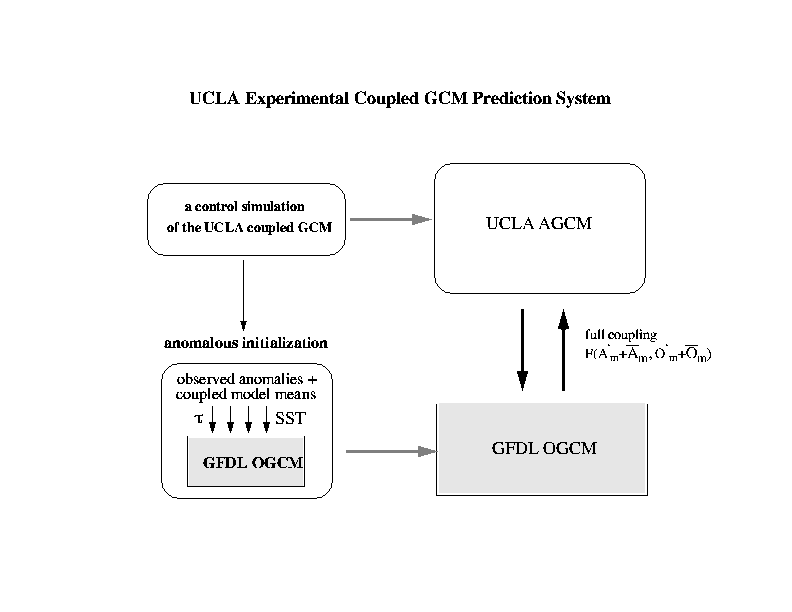
The latest version of the UCLA coupled GCM is able to simulate
ENSO-type variabilities with reasonable amplitudes
(Fig.1).
We are exploring
the potential of this coupled GCM in long-range prediction by focusing
on the ongoing 97-98 El Nino event. The UCLA coupled GCM consists of the
UCLA global atmospheric GCM (AGCM) and a tropical Pacific version of
the GFDL Modular Ocean Model (MOM). The AGCM has 15 layers in the
vertical (with the top at 1 mb) and a horizontal resolution of 5 lon
by 4 lat. The MOM covers a domain from 30S to 50N and from 130E to
70W. This version has 27 layers in the vertical and a constant depth
of 4150 m. The longitudinal resolution is 1 degree; the latitudinal
resolution varies gradually from 1/3 degree between 10S and 10N to
almost 3 degree at 30S and 50N. The surface wind stress and heat flux are
calculated hourly by the AGCM, and their daily averages are passed to
the OGCM. The SST is calculated hourly by the OGCM, and its value at
the time of coupling is passed to the AGCM.
2. INITIALIZATION SCHEME AND FORECASTS
The
initialization scheme
used to generate the initial condition for
the ocean component of the coupled GCM is based on the model
climatology from an extended run and SST and wind stress anomalies
from the CPC (Climate Prediction Center) assimilation and the FSU,
respectively. The initial conditions for the atmosphere are taken
directly from the extended run of the coupled GCM. The ocean state at
the end of the spin-up process is used as the initial condition for
the ocean model. For the prediction of the '97-'98 ENSO, the ocean
model is spun up with observed wind stress and SST anomalies begining
from January 1994. Two forecasts are made in this report. The first
one is made with the ocean condition initialized on June 15, 1997, and
the other one is made with the ocean initialized on July 15 1997.
3. RESULTS
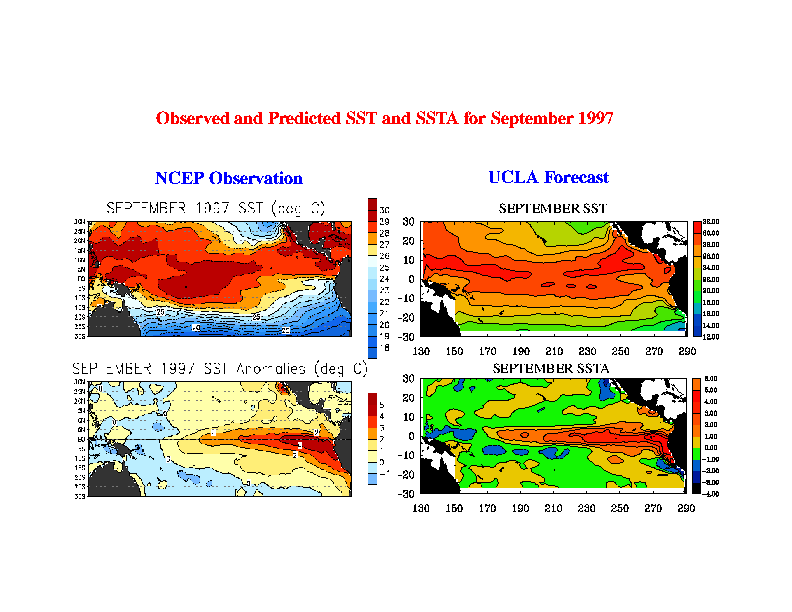
The predicted SSTs and SST anomalies are compared with the September
observations from the NCEP
(Fig. 2) .
The major features of the observed SST are
captured by the experimental prediction, except that the UCLA coupled
GCM is generally 1 degree warmer than the observation. As for the SST
anomalies, the model predicts that the warm water extends from the
South American coasts to the central equatorial Pacific, with the 1
degree SST anomalies reaching the dateline and a maximum warming of
3-4 degree in the eastern equatorial Pacific. Those features are in a
very good agreement with the observation.
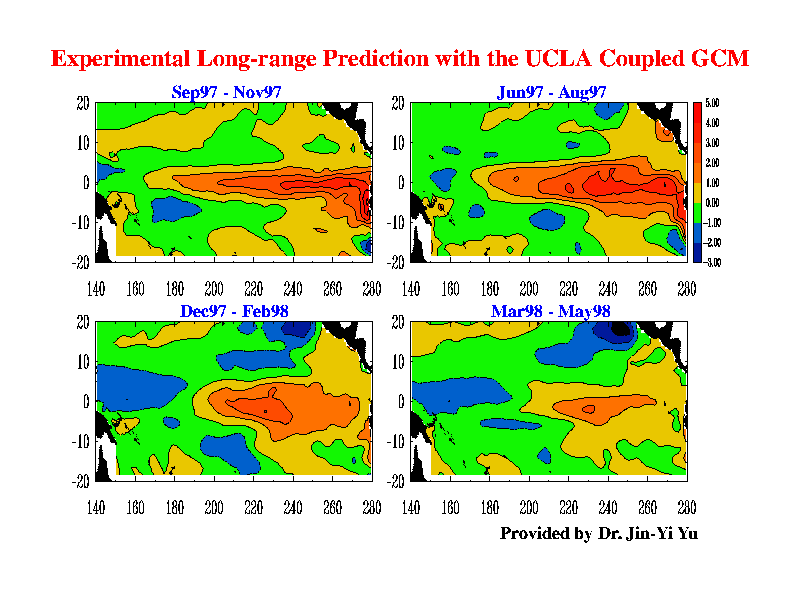
The SST anomalies predicted
(Fig. 3)
by the forecast initialized in June 1997
show that the '97-'98 ENSO has a rapid growth from the June initial
condition to the September-October maximum. The SST anomalies in the
NINO3 region increase by 1.5 degree during this three-months period.
The maximum SST anomalies are predicted to be more than 3 degrees in
October in the eastern equatorial Pacific. The UCLA coupled GCM
predicts that, after October 1997, this ENSO event will enter a slowly
decaying phase and will be terminated after the spring of 1998. This
experimental prediction shows that the '97-'98 ENSO is characterized
by a rapid growing phase followed a slow decaying phase. The SST
anomalies associated with this ENSO are predicted to be still
relatively large (more than 1 degree in the NINO3 region) in the cold
seasons of the 1997-1998. The forecast initialized in July 1997 has a
similar behavior.
4. CONCLUSIONS
Encouraging results are produced from the experimental long-range prediction made with the UCLA coupled ocean-atmosphere GCM for the ongoing '97-'98 ENSO event. The coupled model produces SST prediction that is similar to those observed in June to September of 1997. The UCLA coupled GCM is able to capture the rapid growth feature of this ongoing ENSO event, and its forecast of the NINO3 SST anomalies appears to be close to those forecasts made with several models that have been routinely used for long-range prediction (Fig. 4). This study reveals that the latest version of the UCLA coupled GCM has the potential of making long-term prediction with reasonable success. Hindcast studies are being performed to assess the predictive skill of this coupled model.
Return to HOME